
 Home Home |
| For authors |
| Submission status |
| Current
|
| Archive
|
| Archive
(English)
|
| Search |

Wave tunneling, one of the most basic physical phenomena, appears to be especially interesting when the wave is of vectorial nature as, for instance, the light. In particular, a vector Ginzburg-Landau equation, approximately describing quasi-monochromatic optical field in a weakly non-uniform bulk Epslilon-Near-Zero medium, predicts tunneling of specific toroidal light structures between two distant potential wells.
Each structure is a weakly dissipative transverse-electric mode with angular momentum $l=1$ for a single central-symmetric well.
In contrast, the transverse-magnetic modes, although corresponding to lower "energies", are strongly dissipative under relevant physical parameters.
The optical wave is thus characterized by two complex (pseudo)vectors ${\bf C}_{1,2}(t)$, so that each vector determines the magnitude and spatial orientation of the structure in the corresponding well. Vectors ${\bf C}_1$ and ${\bf C}_2$ are coupled by tunneling interaction, with parameters differing for components along the geometric axis and across it.
The dynamics of tunneling becomes quite non-trivial when nonlinearity is also taken into account as well as dissipative effects and external pumping. It demonstrates non-uniformly
turning tors in both wells, with the wave action flowing in a non-periodic manner from one well to the other and backward.
Direct numerical simulations of the 3D Ginzburg-Landau equation confirm qualitative predictions of approximate system of ordinary differential equations.
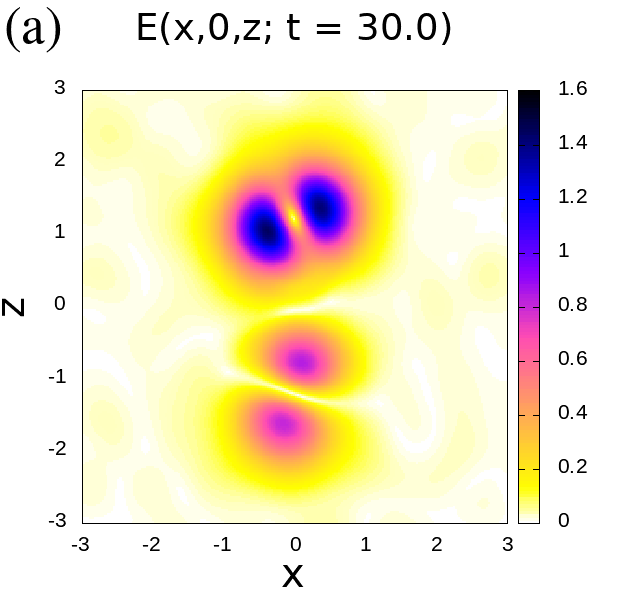
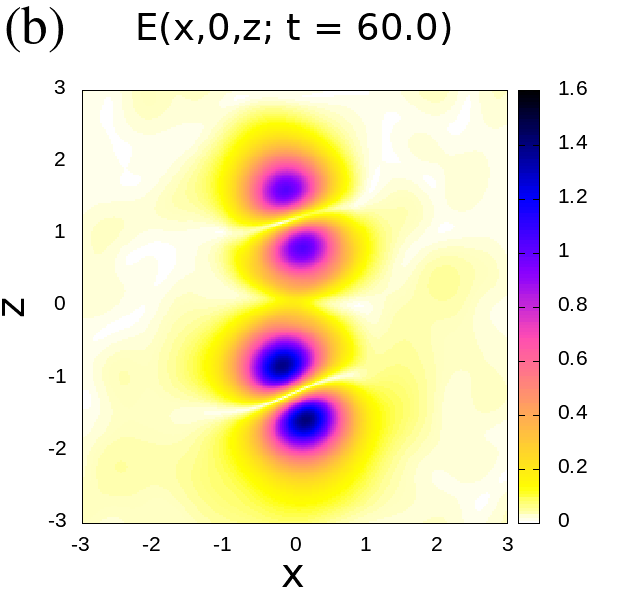
Fig.1a-1b:
Numerical example of two configurations of the optical field differing by the magnitudes and spatial orientations of the toroidal structures.
V. P. Ruban,
JETP Letters 123(10), (2026).