
 Home Home |
| For authors |
| Submission status |
| Current
|
| Archive
|
| Archive
(English)
|
| Search |

The superfluidity of 3He is associated with Cooper pairing of particles with a total orbital angular momentum and spin equal to 1. This allows the existence of superfluid phases with different structures and properties. However, in pure 3He in the absence of magnetic field, only the A and B phases are realized. When 3He is placed in a magnetic field, another phase, the so-called A1 phase, becomes accessible. The region of existence of the A1 phase is linear with respect to the field. Another method for the creation of new phases is the controlled introduction of impurities, which can be achieved by highly porous aerogels. Aerogel is a material consisting of solid strands whose size is much smaller than the distance between them.
When experiments are conducted in pure 3He in nematic aerogel, a pure A phase (instead of the polar phase which is favorable when the aerogel strands are covered with ~3 atomic layers of 4He) is realized with the superfluid transition temperature being noticeably suppressed [1]. Nematic aerogel consists of strands nearly parallel to one another. In pure 3He in aerogel, the transition temperature should also split in magnetic field, but the splitting is expected to be nonlinear at fields below the spin saturation field (~2 T) due to the influence of magnetic scattering [2].
Various resonators, such as a vibrating wire, can be used to study superfluid 3He. Its resonance parameters are determined by the properties of both the wire and the surrounding medium. In experiments with 3He, an aerogel sample is glued to such a vibrating wire. Liquid 3He fills the space between the aerogel strands, causing the resonance parameters to also depend on the properties of the liquid within the aerogel.
In the case of an anisotropic aerogel sample, in addition to the main mechanical resonance of the vibrating wire, a second oscillation mode is also observed. This mode is analogous to the second sound and arises from mutual oscillations of both the normal and superfluid components within the aerogel sample. In the series of experiments, scanning over a wider frequency range allowed us to measure the temperature dependences of the parameters of both resonance modes. Using the data, we were able to study the temperature dependence of the upper transition Tca1 over a wide range of magnetic fields, and we also managed to detect the lower transition Tca2 (from the A1 to the A2 phase) using high magnetic fields up to 3 T, which was not the case at fields <2 T [3].
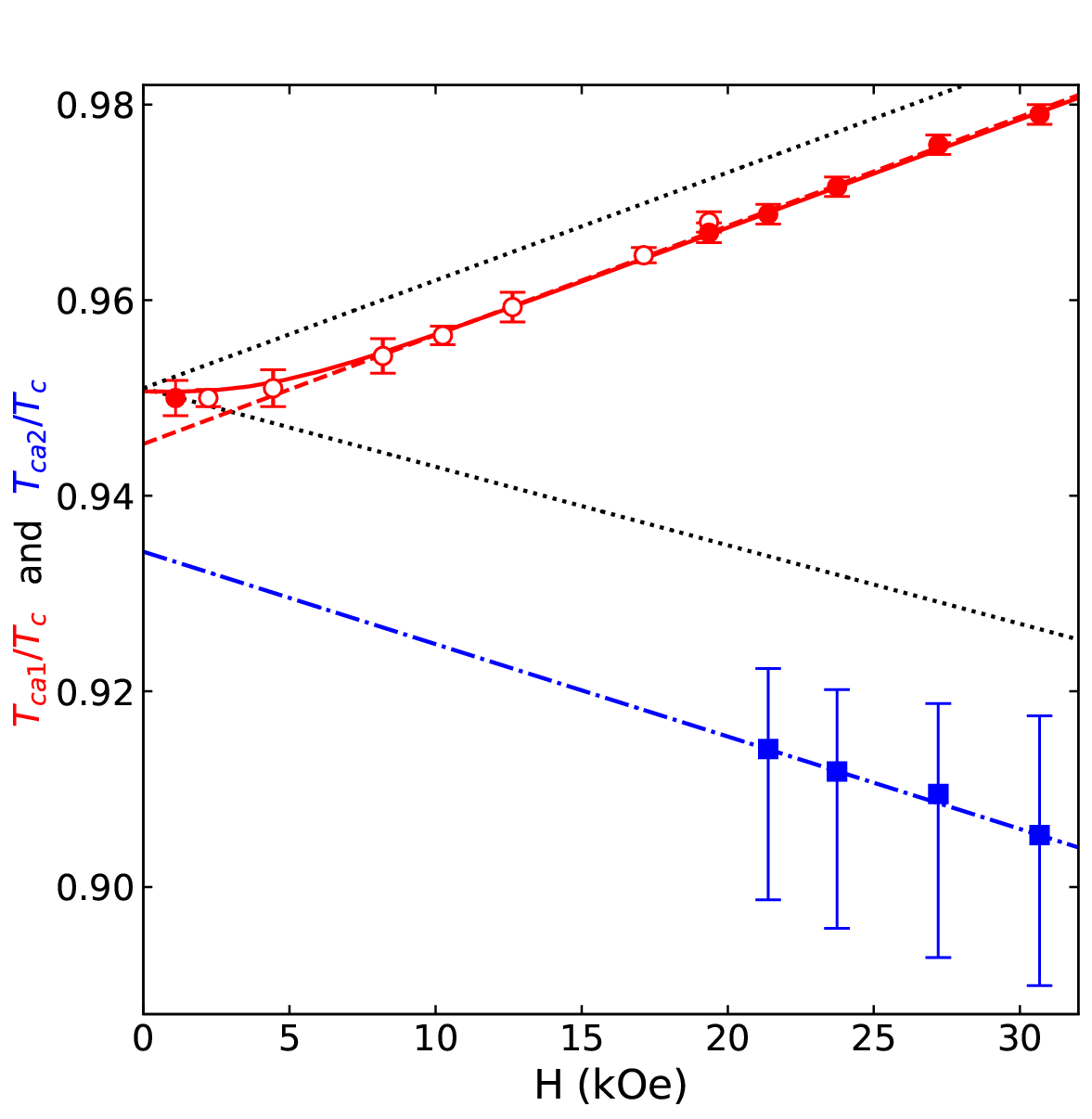
The A1–A2 splitting in pure 3He in nematic aerogel in magnetic field. The circles correspond to Tca1 (open circles are from [3]), the squares correspond to Tca2. The solid line is the best fit with theoretical model of [2], the dashed line is a linear extrapolation of the high-field Tca1 data to a zero field, and the dash-dotted line is a linear fit of the Tca2 data. Dotted lines correspond to the A1–A2 splitting in bulk 3He scaled to a superfluid transition temperature of 0.95Tc, where the superfluid transition temperature in bulk 3He Tc = 2.083 mK.
[1] V.V. Dmitriev, A.A. Soldatov, and A.N. Yudin, Phys. Rev. Lett. 120, 075301 (2018).
[2] G.A. Baramidze and G.A. Kharadze, J. Low Temp. Phys. 135, 399 (2004).
[3] V.V. Dmitriev, M.S. Kutuzov, A.A. Soldatov, and A.N. Yudin, Phys. Rev. B 107, 024507 (2023).
V. V. Dmitriev, M. S. Kutuzov, D. V. Petrova, A. A. Soldatov, A. N. Yudin,
JETP Letters 122, issue 7 (2025)