
 Home Home |
| For authors |
| Submission status |
| Current
|
| Archive
|
| Archive
(English)
|
| Search |

In the past few decades, the intensive development of angle-resolved photoemission spectroscopy (ARPES) made it possible to experimentally observe the electronic band structure for various classes of materials with a high instrumental resolution and in a wide binding energy range. The corresponding ARPES data are represents maps on which the electronic states are characterized by position in energy, in reciprocal space, width and intensity.
On the other hand, the improvement of theoretical methods for calculating electronic band structure also allows one to obtain the spectral function maps. For example, the density functional theory (DFT) and its combination with various methods take into account electronic interactions (for example, LDA+DMFT). This led to the need for a quantitative comparison of the theoretical and experimental electronic bands. For this, in the theoretical and experimental data, it is necessary to compare not only the qualitative energy position of the electronic bands, but also their relative intensities and widths.
In this work, a technique is proposed for taking into account a number of experimental details for theoretical spectral functions: the photoemission cross-section, experimental energy and angular resolutions, the photo-excited hole lifetime effects. The study was done on the high-temperature iron-based superconductors (NaFeAs and FeSe on a SrTiO3 substrate). It is shown that a significant share in the broadening of quasiparticle bands is associated precisely with taking into account the experimental details in the theory.
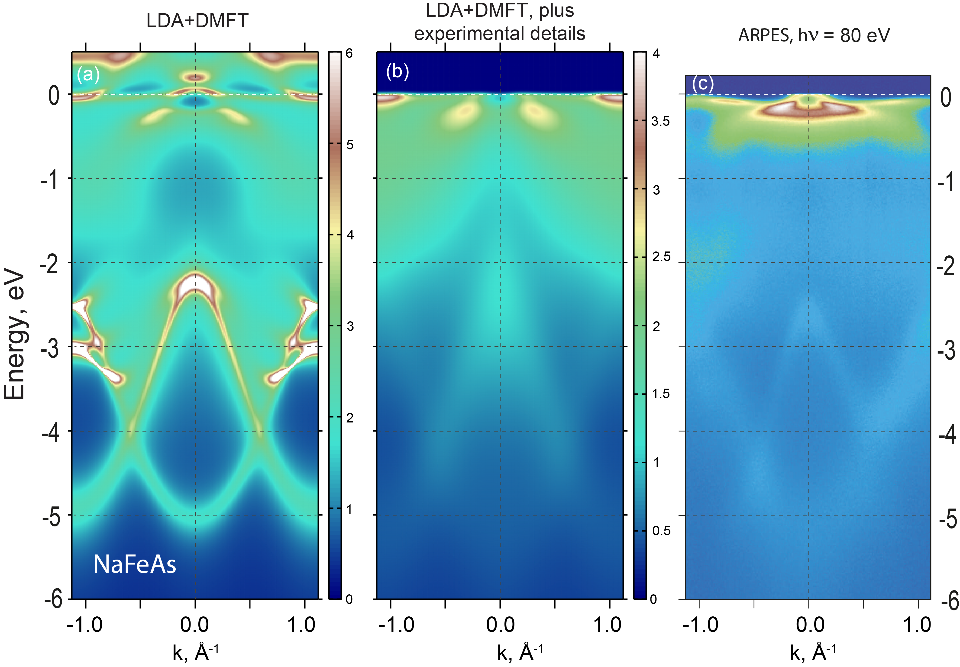
(a) LDA + DMFT spectral function for NaFeAs in the M-G-M direction, (b) taking into account the experimental details, (c) ARPES. Fermi level - zero energy (white dotted line).
I.A. Nekrasov, N.S. Pavlov
JETP Letters 113, issue 2 (2021)