
 Home Home |
| For authors |
| Submission status |
| Current
|
| Archive
|
| Archive
(English)
|
| Search |

The observation of the Anomalous Hall Effect (AHE) in collinear antiferromagnets, despite their vanishing net magnetization, has been a subject of significant interest. The existence of a pseudovector that is responsible for AHE in collinear antiferromagnets is tightly connected with the existence of the Dzyaloshinskii's invariant in the system. While all such invariants in collinear antiferromagnets have been understood for all symmetry classes, the microscopic mechanism of AHE in collinear antiferromagnets is still under research.
In this work we provide a microscopic basis for AHE in all relevant types of collinear and compensated antiferromagnets known to exhibit this effect. We show that such antiferromagnets are collinear weak ferromagnets and collinear ferrimagnets. Although, it is typical to think of weak ferromagnets as antiferromagnets with canted Néel order, in reality weak ferromagnets can have a collinear Néel order with the pseudovector consistent with the Dzyaloshinskii's invariant carried by either conducting fermions or magnons. In addition, we uncover a distinct class of ferrimagnets in which the direction of the pseudovector derived from the Dzyaloshinskii's invariant is parallel with the direction of the Néel order. The
We show that main ingredients behind the AHE in collinear antiferromagnets are shown to be the spin-orbit coupling and spin-splitting of conducting fermions, both derived from the symmetries that allowed for the Dzyaloshinskii's invariant in the system.
There are more weak ferromagnets in Nature than the collinear antiferromagnets without the Dzyaloshinskii's invariant. Typical examples of weak ferromagnets are RuO$_2$, CrSb, CoF$_2$, NiF$_2$, $\alpha$-Fe$_2$O$_3$, MnTe, LuFeO$_3$, MnF$_2$, CoCO$_3$ and many more. Some weak ferromagnets are metallic and some insulating.
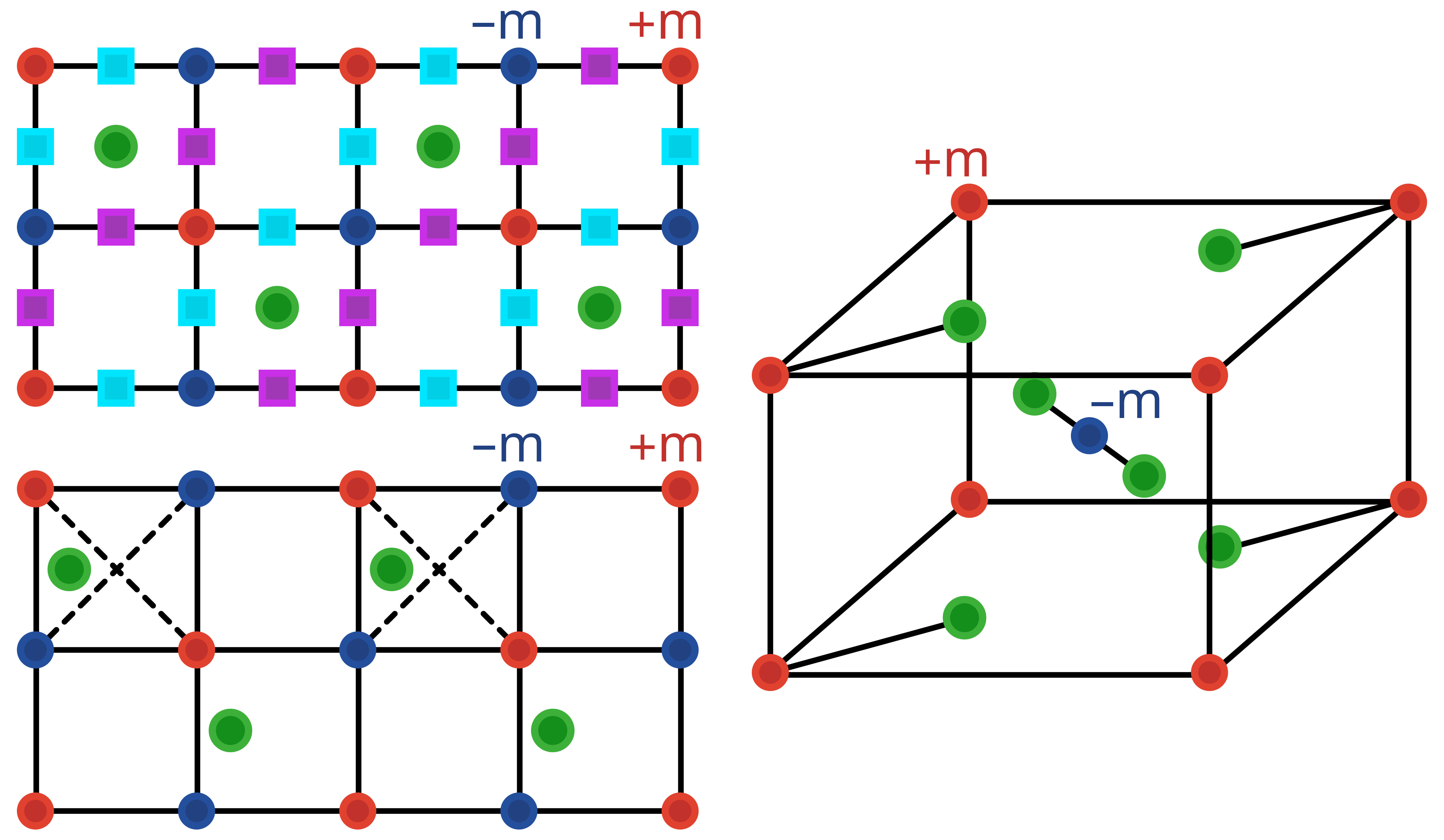
Figure 1: A minimal models of a collinear N\'{e}el ordered d-wave antiferromagnet on a square lattice, ferrimagnet on a square lattice and weak ferromagnet on rutile lattice, illustrating the magnetic (±m) and non-magnetic (green, purple and cyan) sites. This lattice geometry, along with specific symmetry breaking, underpins the emergence of AHE.
V. P. Golubinskii and V. A. Zyuzin
JETP Letters 123, issue 5 (2026)