
 Home Home |
| For authors |
| Submission status |
| Current
|
| Archive
|
| Archive
(English)
|
| Search |

The formation of impurity-induced bound states of a particle hopping over lattice sites is one of the fundamental effects of quantum physics described in numerous textbooks. In the case of the nearest-neighbor hopping, a bound state arises for any strength of the attractive on-site impurity potential W in one- and two-dimensional cases (1D and 2D) and if the strength exceeds a critical value in the three-dimensional (3D) case (this value is determined by the ratio of W/t, where t is the hopping amplitude). The quantum statistics play no role in this single-particle problem. In particular, a similar behavior exhibits a composite boson, formed by two strongly bound fermion species if it is considered as a structureless hard-core particle with an effective hopping amplitude teff = t2/U (U >> t is the strong on-site attraction of the different species) in the presence of an impurity with a non-zero potential acting on the boson as a whole.
Remarkably, that when placed near a single-site "magnetic" impurity—which exerts an opposite effect on its constituent fermions— the composite boson exhibits interesting differences from the well-known single-particle case.
In this case the “classical” potential energy of the bound fermion pair does not depend on the lattice site and this infinite degeneracy is eliminated only through quantum virtual processes of dissociation and recombination. In addition to the band dispersion, these processes also generate an effective impurity potential that extends to the impurity site and its nearest neighbors. This emergent potential gives rise to a rich spectrum of localized states. Besides the usual symmetric bound state, the composite boson supports additional bound states of different orbital symmetry. We determine the energies of these states and the critical impurity strengths required for their formation in one-, two-, and three-dimensional lattices. Notably, the critical conditions are universal: they depend only on the ratio W/U and are independent of the hopping amplitude. Thus, the internal structure of a composite quantum particle can qualitatively transform even the simplest impurity problem. The predicted bound states — analogous to Yu–Shiba–Rusinov states in the weak coupling (BCS) regime — may be relevant to strongly correlated lattice systems, including ultracold atoms in optical lattices, excitonic systems, and other platforms supporting tightly bound quantum pairs.
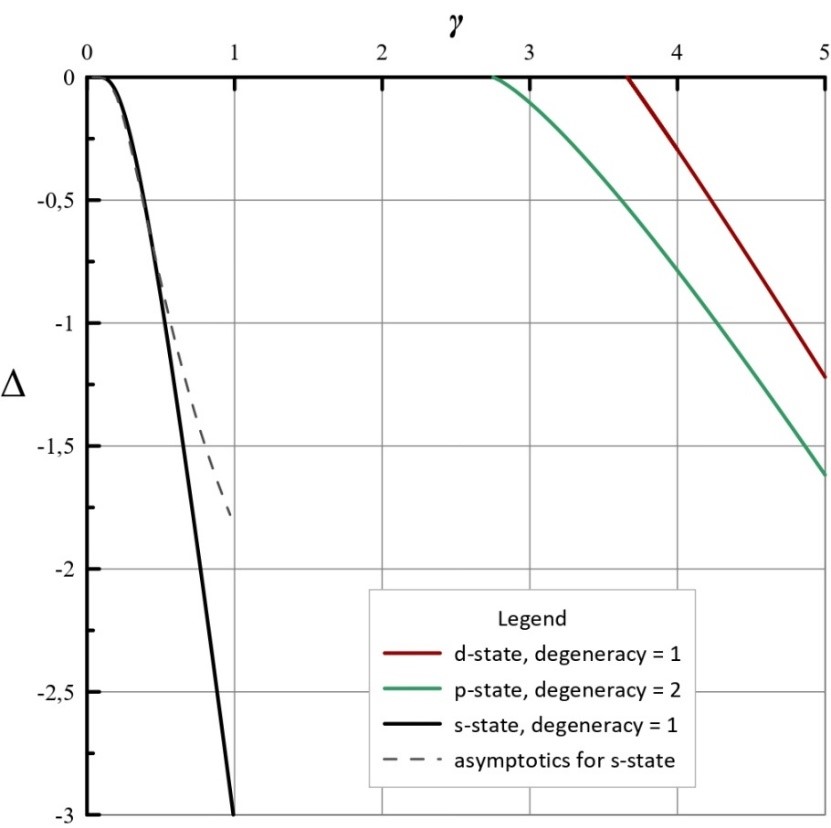
The dependence of the energy of a bound state (counted from the bottom of the band) on the effectiveimpurity strength parameter 𝛾 for a 2D square lattice.
L.I.Knyazeva, V.I.Yudson
JETP Letters 124, issue 4 (2026)