
 Home Home |
| For authors |
| Submission status |
| Current
|
| Archive
|
| Archive
(English)
|
| Search |

The magnonic Bose condensed state was first discovered in superfluid 3He under magnetic resonance conditions. The repulsive interaction between magnons stabilizes this state. The transfer of magnetization by a magnon supercurrent was also discovered [1]. Quite similar phenomena were observed in a nonplanar magnetized film of yttrium iron garnet (YIG), but at room temperature. When the deviation of the magnetization in YIG is more than 3 degrees, the density of non-equilibrium magnons exceeds the critical one [2], and a magnon Bose condensate is formed. Due to the superfluidity of magnons, the BEC state can fill the entire sample and the angles of magnetization deviation exceed 20 degrees [3].
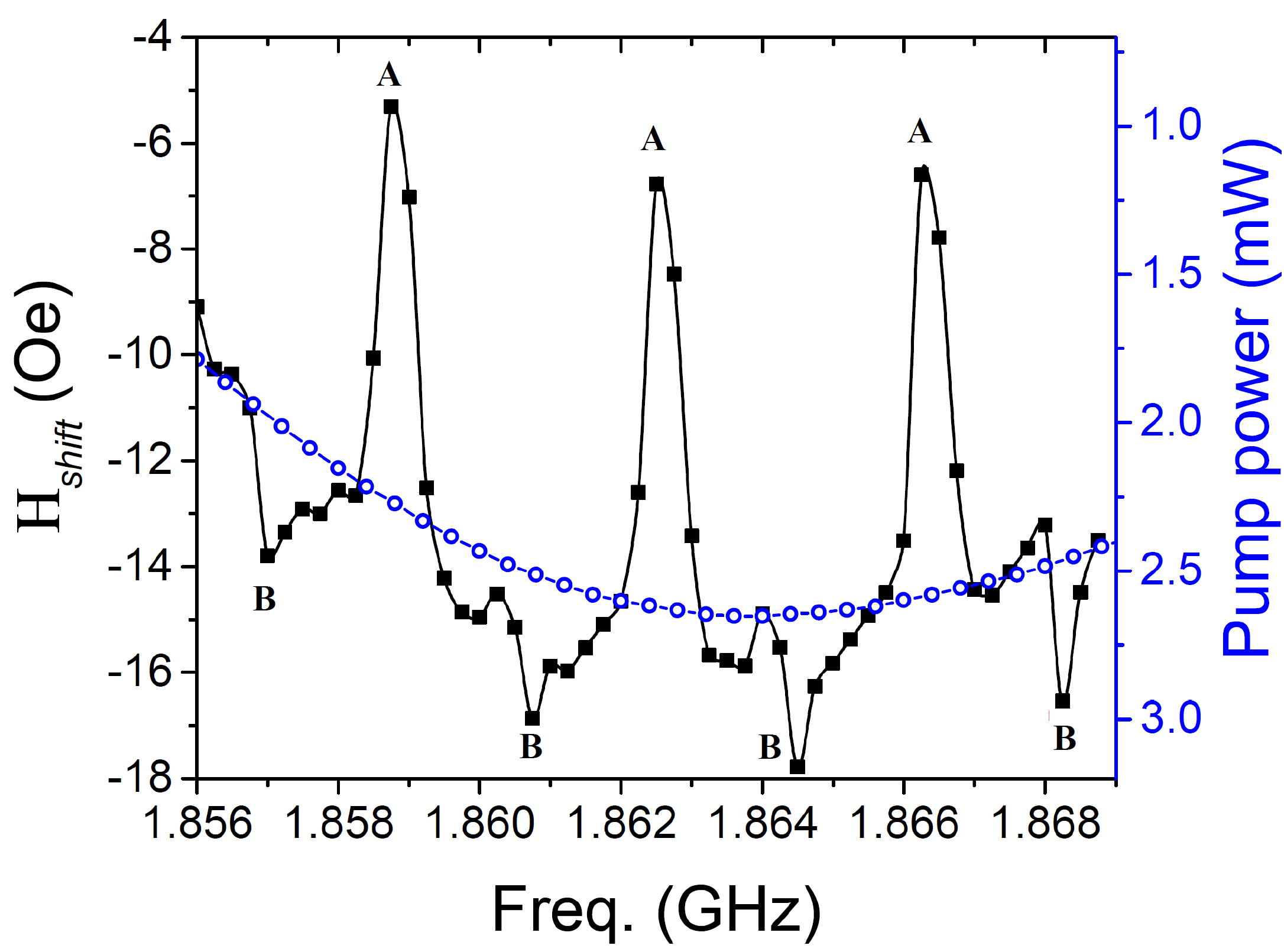
Magnon BEC was studied in a YIG film epitaxially grown on a gadolinium gallium garnet (GGG) plate 0.5 mm thick. The Gilbert attenuation determines the field shift of the BEC observation. It has been found to be highly frequency dependent. It increases significantly when the frequency matches the standing sound waves in the GGG (peaks A in Fig. 1). The magnetoelastic interaction excites phonons, which dissipate energy. Unexpectedly, we also detected antiresonant signals (dips B in Fig. 1). We can explain this by the coherent mediation of circularly polarized phonons, which return their angular momentum after being reflected from the other side of the GGG plate. This observation shows the coherent transfer of the angular momentum of phonons through non-magnetic material on a macroscopic distance.
[1] G. E. Volovik, J. Low Temp. Phys., 153, 266 (2008)
[2] Yu.M.Bunkov, V. L. Safonov, J. Mag. Mag. Mat., 452 30–34 (2018)
[3] P. M. Vetoshko, G. A. Knyazev, A. N. Kuzmichev, A. A. Cholin, V. I. Belotelov, Yu. M. Bunkov, JETP Letters 112, 313 (2020).
P. M. Vetoshko, G. A. Knyazev, A. N. Kuzmichev, V. I. Belotelov, Yu. M. Bunkov
JETP Letters 112, issue11 (2020).