
 Home Home |
| For authors |
| Submission status |
| Current
|
| Archive
|
| Archive
(English)
|
| Search |

In recent years, there has been a surge of interest in developing new approaches to improve the efficiency of existing computational methods or create fundamentally new paradigms. A particularly promising way is the shift from digital computing schemes to analog systems. One such physical system capable of emulating the structure of artificial neural networks are the diffractive neural networks. In this architecture, computation occurs passively and at the speed of light as a coherent wavefront propagates through spatially engineered diffractive layers, performing predetermined operations. However, successfully offloading computations onto an analog physical platform presents a significant challenge: it requires precise and accurate mathematical modeling that faithfully accounts for all the intricacies of the physical implementation. Any discrepancy between the numerical model and the real-world system can lead to computational errors and degraded performance.
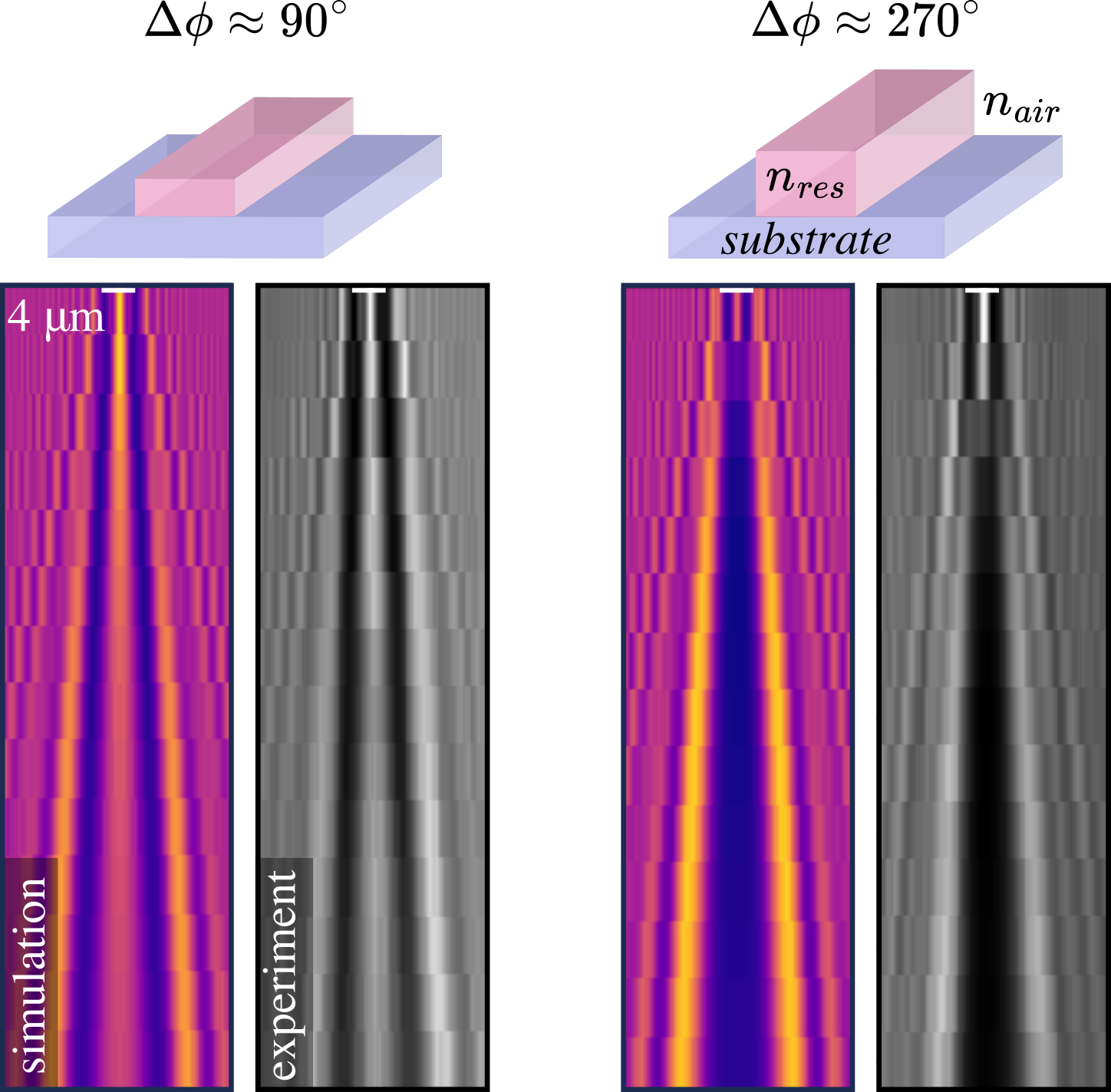
In this work, we directly address this challenge. We experimentally validate the correctness of our numerical modeling framework for a Fourier-diffractive neural network, in particular, we check the fidelity of using the fast Fourier transform to calculate the propagation of light in free space and its interaction with the lens and directly demonstrate the legitimacy of using the pixel of the phase mask as a weighting factor of the neural layer. Furthermore, we perform a comprehensive numerical investigation into how the exact geometry of the optical system influences the final accuracy of the computations. This study provides essential insights and design rules for bridging the gap between theoretical models and robust, high-fidelity physical mplementations of optical neural networks.
Konovalova A., Popkova A., Baluyan T., Fedyanin A.
JETP Letters 123, issue 2 (2026)