
 Home Home |
| For authors |
| Submission status |
| Current
|
| Archive
|
| Archive
(English)
|
| Search |

In this work, an experimental scheme and results on direct detection of the normalized second-order correlation function g(2) of the optical-terahertz biphoton fields are demonstrated for the first time. Optical – terahertz biphotons, the quantum-correlated photon pairs consisting from one photon of optical frequency and one terahertz frequency photon, were generated via spontaneous parametric down conversion in a nonlinear crystal Mg:LiNbO3 pumped by nanosecond pulses of optical laser radiation. The terahertz part of the biphoton field was detected by an analog superconducting hot electron bolometer, the optical part was recorded using the single-photon avalanche photodiode or an analog photomultiplier tube. The methods developed for investigation and quantitative measuring of the quantum correlation characteristics of the optical – terahertz biphotons will be of key importance in future applications of quantum optical technologies, such as quantum sensing, photometry, ghost imaging, in the terahertz frequency range.
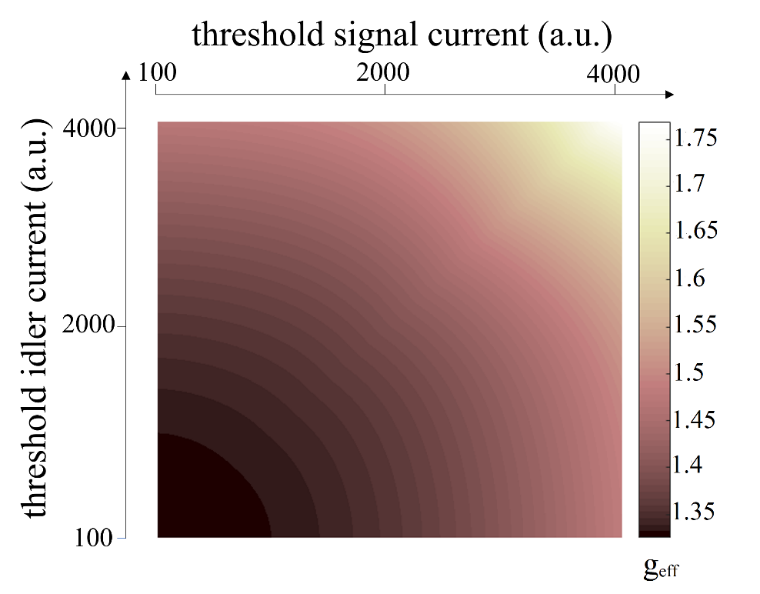
The left figure shows the pump power dependences of the biphoton correlation function g(2). The values of g(2) were obtained with a specially proposed heralding method for discrimination of noise readings of the analog bolometer which were recorded simultaneously with the noise samples from the single-photon optical detector. The direct measuring results are in a good agreement with theoretical predictions on the quantum excess of g(2) over its classical level 1 for the multimode field. Another method of direct discrimination of the readings below some selected threshold values, applicable to readings of both analog optical and terahertz receivers, was tested at different threshold levels. The right figure demonstrates dependence of the effective correlation function geff, evaluated by this method, on the threshold signal and idler photocurrents. It is shown that application of this method makes it possible to register high effective levels of biphoton correlation due to attraction of additional contributions from correlation functions of higher orders.
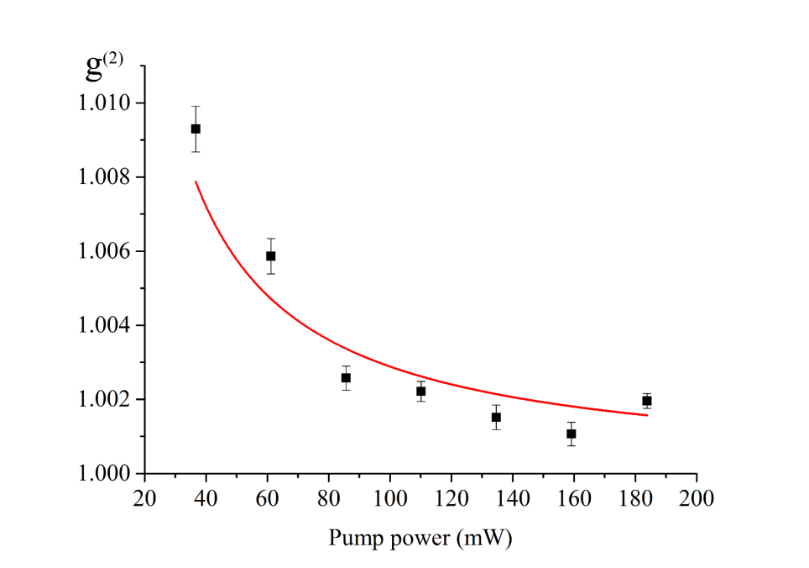
Left: Pump power dependences of the normalized second-order biphoton correlation function g(2).
Right: Threshold signal and idler current dependences of the effective biphoton correlation function geff.
A.A. Leontyev, K.A. Kuznetsov, P.A. Prudkovskii, D.A. Safronenkov, G.Kh. Kitaeva
JETP Letters 114, isuue 11 (2021)