
 Home Home |
| For authors |
| Submission status |
| Current
|
| Archive
|
| Archive
(English)
|
| Search |

One prominent phenomenon in relativistic nucleus-nucleus collisions is jet quenching due to medium-induced partonic energy loss. The observable most directly associated with jet quenching is the suppression of the yield of hadrons with a high transverse momentum pT, which is quantified by the nuclear modification factor, RAA (pT, η). It is defined as the ratio of the inclusive single-hadron yield per unit pseudorapidity η in AA collisions to the corresponding yield in pp collisions, scaled by the average number of binary nucleon-nucleon collisions. In this paper, we investigate the double nuclear modification factor, which was introduced in [1], to simultaneously probe initial and final state effects. We consider a more general case where both hard particles experience energy loss. The hypothesis of the factorization of this factor
RAA (pT1, η1; pT2, η2) = F∙RAA (pT1,η1)∙RAA (pT2,η2)
is tested for different types of final-state hadrons within the framework of the HYDJET++ model.
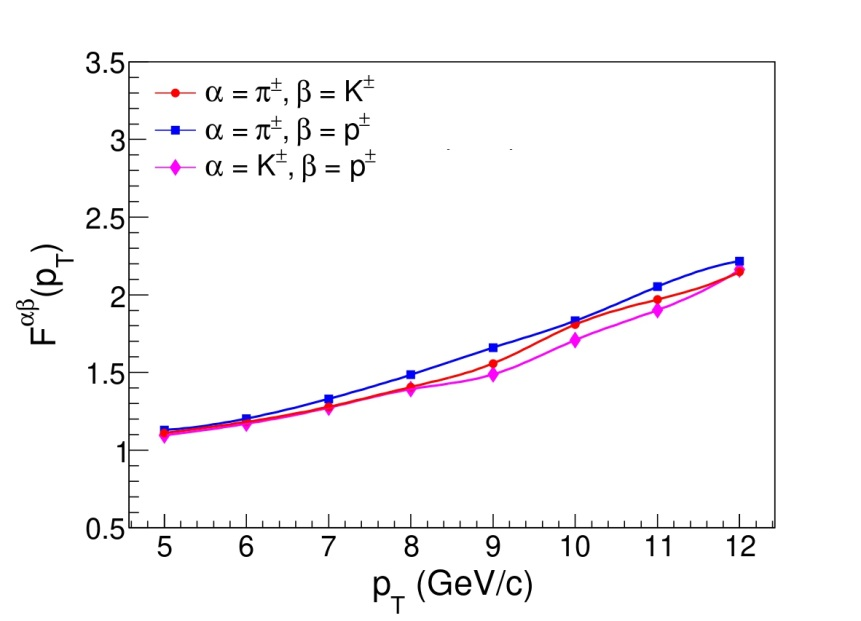
Fig.1 The dependence of the ratio F of the double and the product of single nuclear modification factors on the minimum value of the hadron transverse momentum pT .
The deviation F from factorization of the production pions in association with kaons and (anti-)protons as well as the production of kaons in association with (anti-)protons was calculated for central PbPb collisions at center-of-mass energy 5.02 TeV per nucleon pair (Fig. 1). Results indicate that the hypothesis of factorization holds reasonably well at moderately high pT, provided that the effects of double parton scattering can be small or neglected. However factorization violation starts to show at very high pT. This supports the conclusion that measurements of the double nuclear modification factors offer significant potential for further investigations.
[1] S.P. Baranov, A.V. Lipatov, M.A. Malyshev, and A.M. Snigirev, JETP Letters 119, 823 (2024)
A. S.Chernyshov, I.P. Lokhtin, A.M. Snigirev
JETP Letters 122, issue 5 (2025)