
 Home Home |
| For authors |
| Submission status |
| Current
|
| Archive
|
| Archive
(English)
|
| Search |

The interfaces between superconductors (S) and ferromagnets (F) are known to be the origin of rich physics associated with the proximity effect. The exchange field inside the ferromagnets converts the spin-singlet Cooper pairs into the spin-triplet ones. Such unusual spin structure of superconducting correlations is responsible for the spatial oscillations of the Cooper pair wave function and a great variety of resulting interference phenomena.
Recently, it has become clear that the proximity effect also drastically modifies the electrodynamics of S/F structures. As an example, spin-triplet pairs can damp the usual diamagnetic Meissner response down to zero, and its vanishing was shown to be the hallmark for the emergence of the peculiar Fulde-Ferrell-Larkin-Ovchinnikov (FFLO) phase with the superconducting order parameter modulated in the plane of the layers [1, 2]. Another electromagnetic consequence of the proximity effect is the anomalous long-range transfer of the magnetic field from the ferromagnet to the superconductor even in the case when the F layer does not produce a stray magnetic field [3, 4]. This so-called electromagnetic proximity effect originates from the generation of the superconducting currents inside the F layer due to the direct proximity effect and the subsequent appearance of the compensating Meissner currents flowing in the S layer.
In this paper we review the recent results related to the physics of the in-plane FFLO states and electromagnetic proximity effect in S/F hybrids. Also we analyze the interplay between these two phenomena revealing through the boosting of the spontaneous magnetic field generated in the S layer due to the electromagnetic proximity effect in the vicinity of the phase transition from the uniform superconducting state to the in-plane FFLO phase.
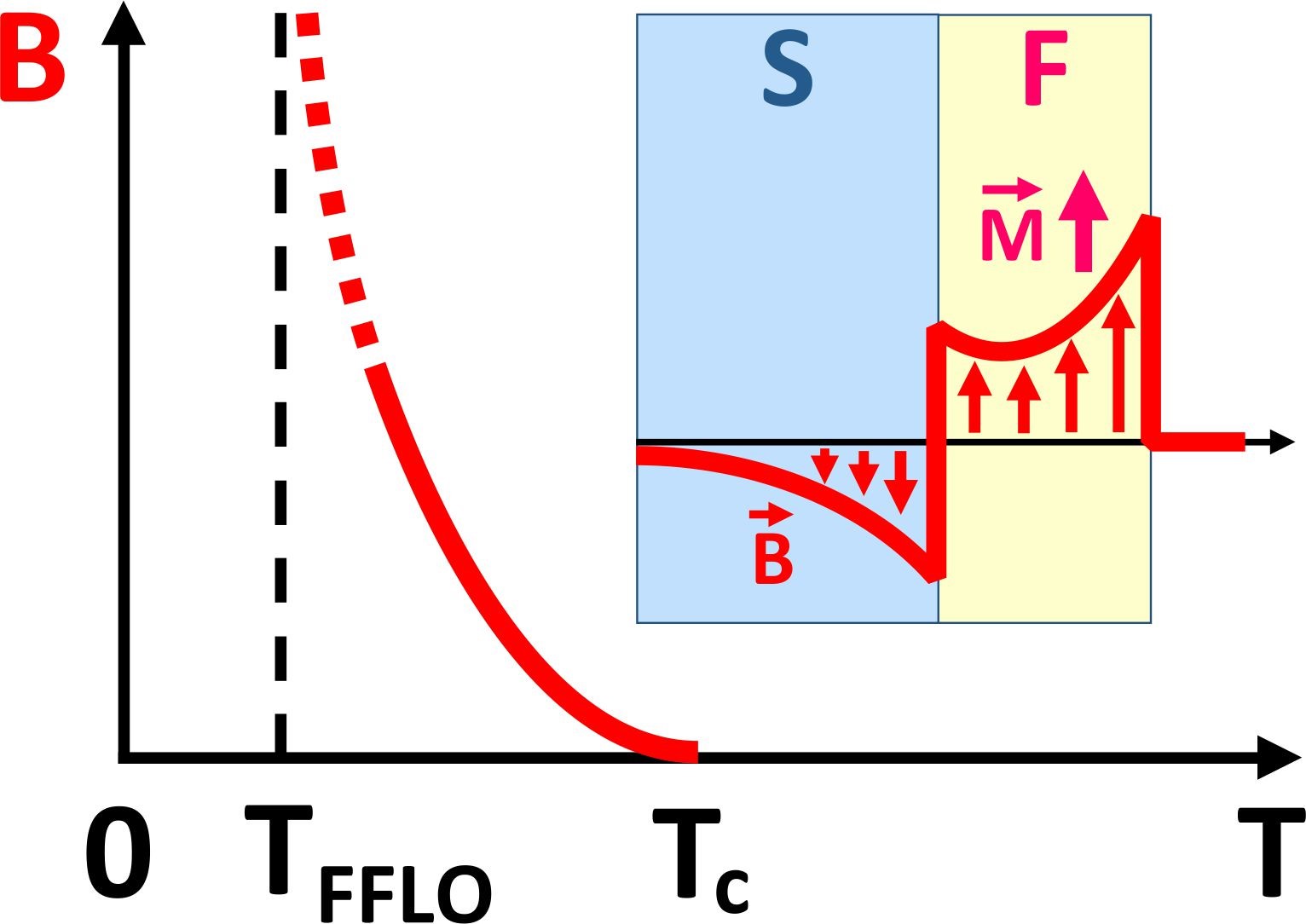
Leakage of the magnetic field from the ferromagnet to the superconductor due to the electromagnetic proximity effect and qualitative plot illustrating the increase in the amplitude of the spontaneous magnetic field when approaching the transition to the FFLO phase (with the decrease of temperature).
[1] S. Mironov, A. Mel’nikov, A. Buzdin, Phys. Rev. Lett. 109, 237002 (2012)
[2] S. V. Mironov, D. Yu. Vodolazov, Y. Yerin, A. V. Samokhvalov, A. S. Mel’nikov, A. Buzdin, Phys. Rev. Lett. 121, 077002 (2018)
[3] S. Mironov, A. S. Mel’nikov, A. Buzdin, Appl. Phys. Lett. 113, 022601 (2018)
[4] Zh. Devizorova, S. V. Mironov, A. S. Mel’nikov, A. Buzdin, Phys. Rev. B 99, 104519 (2019).
S. V. Mironov, A. V. Samokhvalov, A. Buzdin, A. S. Mel’nikov
JETP Letters 113, issue 2 (2021)