
 Home Home |
| For authors |
| Submission status |
| Current
|
| Archive
|
| Archive
(English)
|
| Search |

This work presents a theoretical method to estimate the transparency of grain boundaries in granular superconducting films. The study is motivated by the need to better understand how grains boundary influence
the superconducting properties and vortex physics in such materials. Scanning tunneling microscopy (STM) allows high-resolution measurement of the local density of states (LDOS) in superconductors, revealing variations related
to Abrikosov vortices and grain boundaries.
Physical Picture. Vortices in thin superconducting films are strongly affected by the transparency of grain boundaries. Vortex cores can be pinned at the boundaries or inside the grains. The spatial variation of the
superconducting order parameter and LDOS around vortex cores reflects these pinning scenarios.
Theoretical Model. The film is modeled as a network of cylindrical grains with boundaries of finite transparency, characterized by a boundary resistance parameter 𝑅𝐵 . The first scenario is considered when the
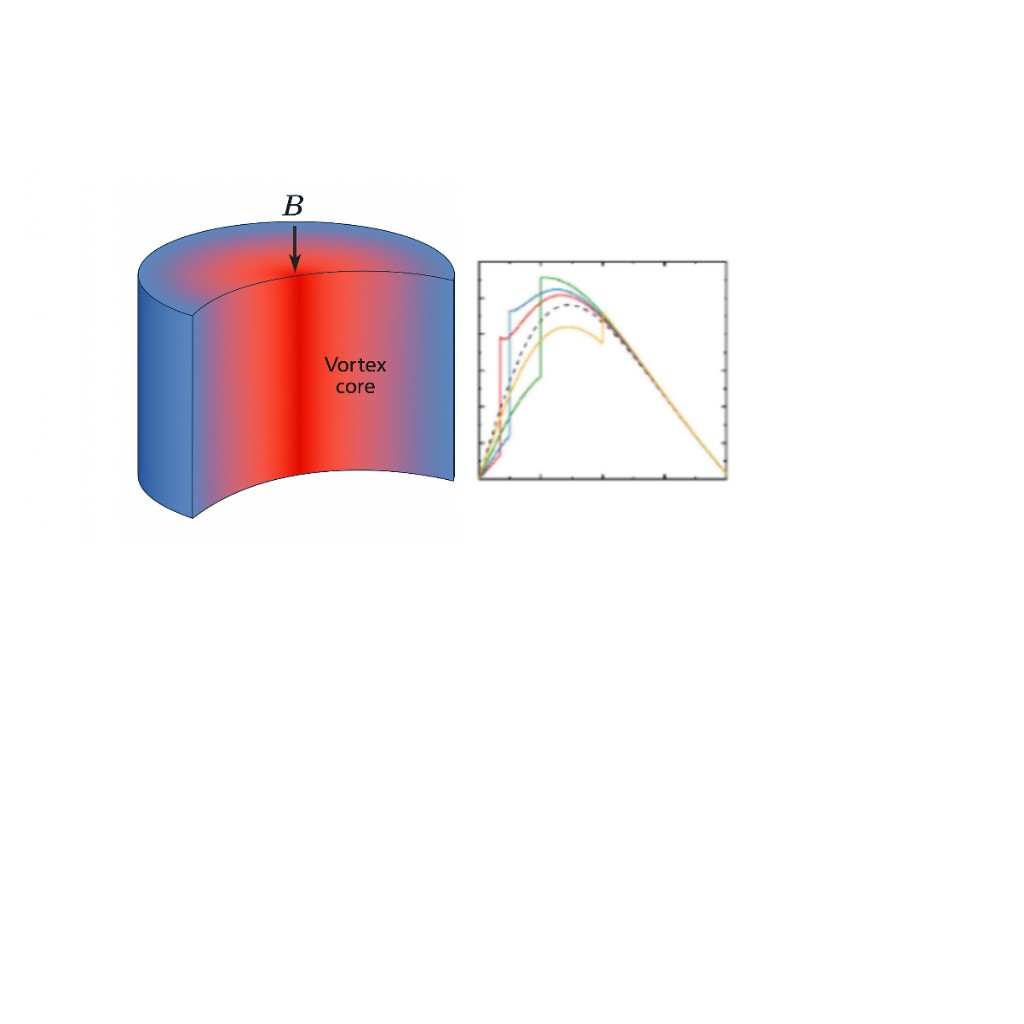
vortex is located in the grain center. The Usadel equations for dirty superconductors are solved in the circular cell approximation, with appropriate boundary conditions accounting for interface transparency. Numerical Results. Calculations show that the order parameter and shielding current density exhibit sharp
jumps at grain boundaries, the magnitude of which depends on the interface transparency and the grain size. The LDOS also changes abruptly at the boundary, with the difference between LDOS values on both sides of the
interface serving as a direct measure of boundary transparency.
Experimental relevance. The approach provides a practical route to extract an information about intergranular transparency from STM measurements of the LDOS near vortices in granular films. It is shown that boundaries located several coherence lengths from the vortex center provide the most sensitive data for this estimation. The developed method offers a way to diagnose the electronic quality of grain boundaries in superconducting films, which is crucial for optimizing performance of superconducting electronics and devices. The figure shows Abrikosov vortex in a cylindrical grain (left) and the dependencies of the magnitude of the
screening current density J on the distance r from the vortex core for various grain sizes.
Khapaev M.M., Kupriyanov M.Yu., Golubov A.A., Stolyarov V.S.
JETP Letters 122, issue 2 (2025)