
 Home Home |
| For authors |
| Submission status |
| Current
|
| Archive
|
| Archive
(English)
|
| Search |

Laser thermonuclear fusion targets with calculated values of the volume and surface densities of compressed deuterium-tritium fuel of 200-300 g×cm-³ and 1-2 g×cm-2, respectively, are proposed for irradiating nanosecond laser pulse with an energy of 300-500 kJ, which is achievable in a modern experiment. These compression characteristics correspond to the possibility of achieving a thermonuclear gain (the ratio of the released fusion energy to the total expended energy) of 40-60 upon subsequent fast ignition with a beam of laser-accelerated protons.
The main feature of these targets is the high specific mass of deuterium-tritium fuel per unit of compressing laser pulse energy (2-3 mg×MJ-1), which is 5-7 times greater than that of a traditional spark ignition target. In addition, the fraction of absorbed energy of the 2nd harmonic Nd laser pulse is 60-70%, which is almost 2 times more than in the case of a traditional target.
Figure shows an example of scheme of two-layer shell target for fast ignition with a fuel mass of mDT =0.905 mg (a) and a time-dependence of corresponding laser pulse power (WL) and the absorbed laser flux fraction δabs (b) for pulse energy 500 kJ.
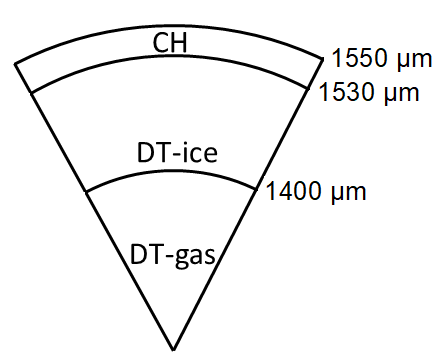
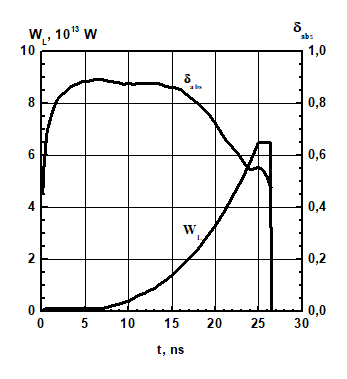
Fig. Typical example of two-layer shell target for fast ignition with a mass of mDT =0.905 mg (a); time-dependence of laser pulse power (WL) with energy 500 kJ and the absorbed laser flux fraction δabs (b).
S.Yu. Gus’kov, N.N. Demchenko, R.A. Yakhin
JETP Letters 123, issue 10 (2026)