
 Home Home |
| For authors |
| Submission status |
| Current
|
| Archive
|
| Archive
(English)
|
| Search |

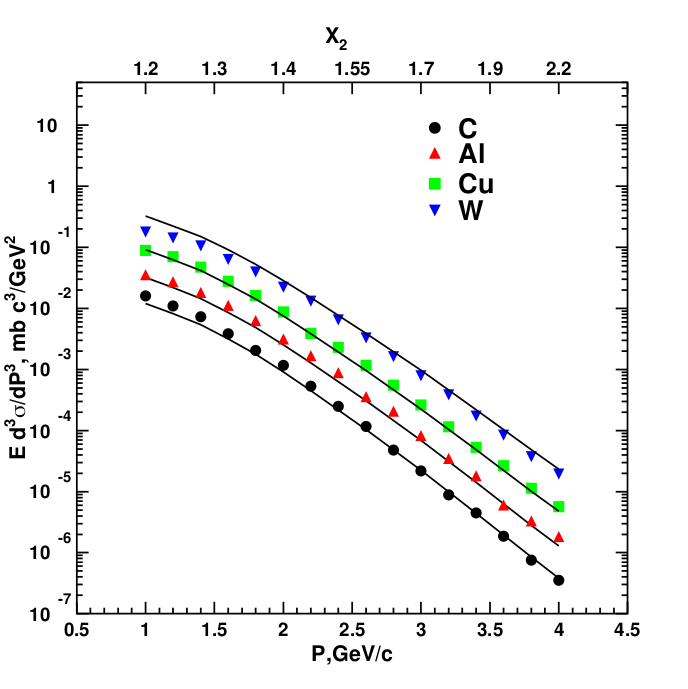
The cumulative process is particle production in a kinematical region forbidden for reactions with free nucleons. The SPIN set up provides a detailed study of charged particles emitted with high transverse momentum ( pT > 1 GeV/c) from nuclear targets irradiated with protons from the U70 accelerator of the Institute for High Energy Physics. The working kinematic region of the SPIN experiment makes it possible to study the cumulative particle production caused by hard interactions with dense multiquark (multinucleon) configurations inside nuclear matter. Cross-sections for the antiproton production as a function of momentum are presented in the left figure for four targets, C, Al, Cu and W. The upper horizontal axis shows the X2 values (“Stavinsky variable” [1]), which corresponds to the minimum target mass required to produce antiprotons at an angle of 400. The curves in the left figure are calculations in accordance with the parameterization [2], in which the dependence of the cross sections on the nuclear mass (A) is represented by ~$A^{(2.4+X_2)/3}$. Close to universal for all targets X2-dependence is an evidence for formation of antiprotons in interactions with multinucleon (multiquark) configurations inside a nucleus.
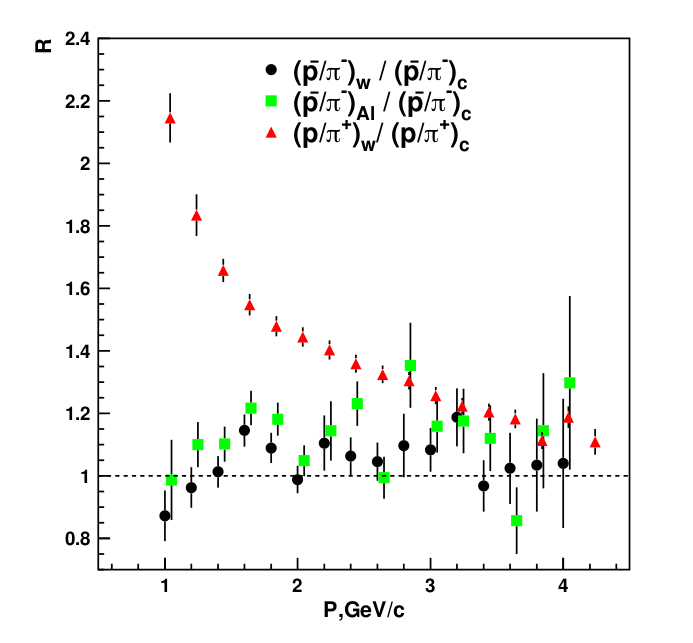
At first glance, the ratio between the yields of antiprotons and $\pi $ mesons looks the same for different nuclei. However, if to devide ($\bf \vec p / \bf \pi^-$) values measured for the heavier nucleus by for carbon target (as it is done in the right figure) one can see that the double ratio does systematically exceed unity, which may indicate certain impact of FSI. The double ratio constructed using the proton and $\pi $spectra from tungsten and carbon samples shows a much stronger influence of secondary processes on the inclusive spectra of proton.
[1] V. S. Stavinskii, JINR Rapid Comm. 18, 5 (1986)
[2] N.N. Antonov et al., Physics of Atomic Nuclei, 2022, Vol. 85, No. 3, pp. 282–288.
N.N. Antonov et al.,
JETP Letters 119, issue 1 (2024)