
 Home Home |
| For authors |
| Submission status |
| Current
|
| Archive
|
| Archive
(English)
|
| Search |

This work is devoted to theoretical studies of methods for obtaining and experimental identification of superhard hexagonal (2H) diamond (Fig. 1a). Calculations showed that the most probable way to obtain 2H diamond is to treat cubic (3C) diamond with [211](111) shear stress exceeding 102.9 GPa at an average pressure of ~ 37.7 GPa (Fig. 1b). We also calculated spectral characteristics of hexagonal diamond and other diamond polytypes. It is established that hexagonal diamond can be unambiguously identified if there are no other diamond polytypes with non-zero hexagonality in the system under study. In addition, Raman and electron energy loss spectroscopy data were analyzed for the presence of 2H diamond polytype in carbon compounds of artificial or natural origin. The analysis showed that pure hexagonal diamond has not yet been obtained, and the structure of the synthesized compounds is close to the structure of polytypes with a large lattice period or random layer packing.
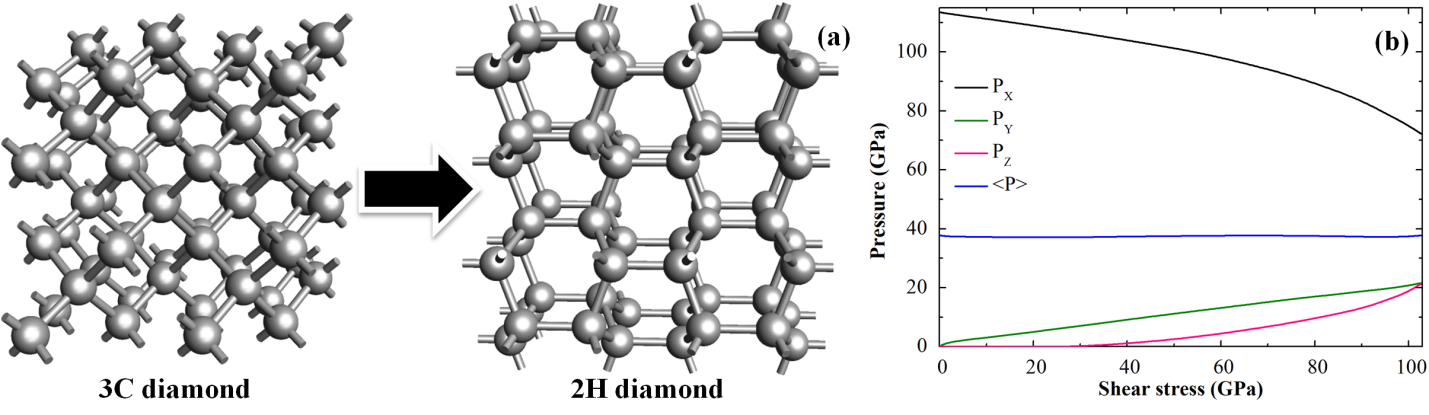
Figure 1. (a) Crystal structures of 3C and 2H diamond polytypes. (b) Pressure versus shear stress during the phase transition of cubic diamond to hexagonal diamond.
V.Greshnyakov
JETP Letters 117, issue 4 (2023)