
 Home Home |
| For authors |
| Submission status |
| Current
|
| Archive
|
| Archive
(English)
|
| Search |

Self-organized quantum dots (QDs) grown by the epitaxial method are considered as the basis for various applications in quantum photonics due to their unique properties, such as small spectral linewidth, fast radiative decay time, and high quantum efficiency. Among such applications is the generation of single photons with a high degree of indistinguishability, which is necessary for the implementation of linear optical quantum computing schemes. Most modern quantum computing protocols require a sufficiently large number of parallel channels with indistinguishable photons. One of the approaches to their formation is the use of many independent QDs emitting photons identical in all parameters. Another approach is based on the use of only one perfect QD, which emits with a high efficiency a sequence of single-photon pulses, which are then demultiplexed over N parallel channels.
In this letter, we demonstrate the possibility of combining these two approaches by creating high-quality single-photon sources, which in principle allow integration within a single semiconductor chip. For this purpose, structures were fabricated with a self-assembled InAs/GaAs QD placed in a columnar optical microcavity with distributed Bragg reflectors, possessing a relatively low Q factor. The experiment on measuring two-photon interference, performed in the Hong-Ou-Mandel scheme at various delays between two photons successively emitted under resonant coherent excitation of a single QD, showed the possibility of achieving up to 93% indistinguishability at a 250 ns delay. It is assumed that the use of such microcavity structures with a low Q factor and a sufficiently wide spectral resonance will simplify the precise tuning of the single-photon generation wavelength, which will make it possible to increase the number of parallel channels in the circuits of optical quantum computers by integrating several independent sources of indistinguishable photons with a degree of indistinguishability sufficient to effectively demultiplex the photon flux emitted by each source.
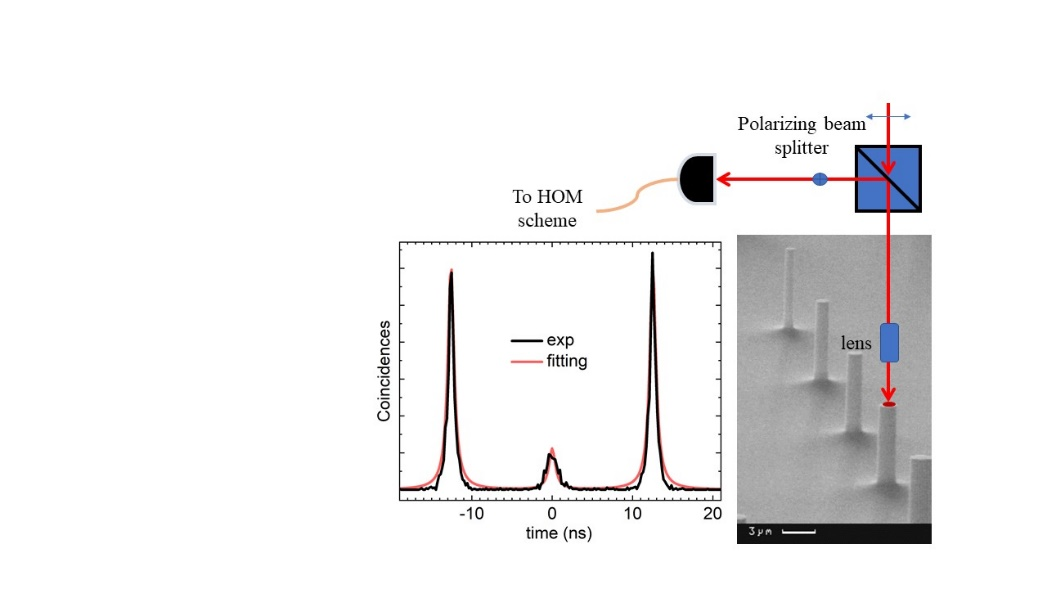
A histogram measured in the Hong-Ou-Mandel scheme of two-photon interference with a delay between photons of 250 ns under conditions of resonant coherent excitation by a π-pulse of a microcavity with a single InAs/GaAs QD.
Galimov A.I., Rakhlin M.V., Klimko G.V. et al.
JETP Letters 113, issue 4 (2021)