
 Home Home |
| For authors |
| Submission status |
| Current
|
| Archive
|
| Archive
(English)
|
| Search |

In the absence of reliable experimental data, theoretical studies became the primary approach to understanding neutral excitations in fractional quantum Hall states. An analogy between the lowest-energy excitations of certain fractional states (Laughlin liquids) and gravitons - quanta of the gravitational field - was discovered theoretically. For this reason, the lowest-energy neutral excitations of Laughlin liquids with zero momentum are called chiral gravitons or magnetogravitons. Previously, the authors proposed a technique that uses light reflection to detect analogs of chiral gravitons in the Laughlin liquid. Those are neutral excitations with a change in the spin quantum number of the electron system by one - spin-magnetogravitons (SMG). It turned out that SMGs with zero momentum can have unprecedentedly long lifetimes, although the relaxation dynamic of these excitations is non-monoexponential. This suggests that the description of the SMG system as an ensemble of identical, non-interacting quasi-particles is insufficient to explain the existing experimental data.
In this paper, we investigated the long-term relaxation of SMG ensembles in a Laughlin liquid at an electron filling factor of 1/3. Studying the time dynamics of such long-lived excitations presents a significant experimental challenge. To address this, the resonance reflection (RR) technique and coherent anti-Stokes-Stokes Raman scattering of light (aSSR) were employed. Both scattering processes contribute to the reflection spectrum, but their intensities vary differently on the change in the excitation power. The RR signal is linear across the full range of powers, while the aSSR signal exhibits a nonlinear dependence on the excitation power due to the formation of the SMG ensemble. As a result of measuring the relaxation processes of SMGs at different laser powers and excitation spot sizes, it was shown that there are two types of these excitations (bright and dark). The lifetimes of dark SMGs can reach hundreds or thousands of seconds at a temperature of 0.6 K, whereas the lifetimes of bright SMGs are less than one second. The maximal amount of SMGs diluted in the Laughlin liquid is constant, but the ratio of the dark and bright SMGs can be varied experimentally by rising the SMG density. It seems the dark SMGs are quasi-particles organized in a novel condensed state in the Laughlin liquid.
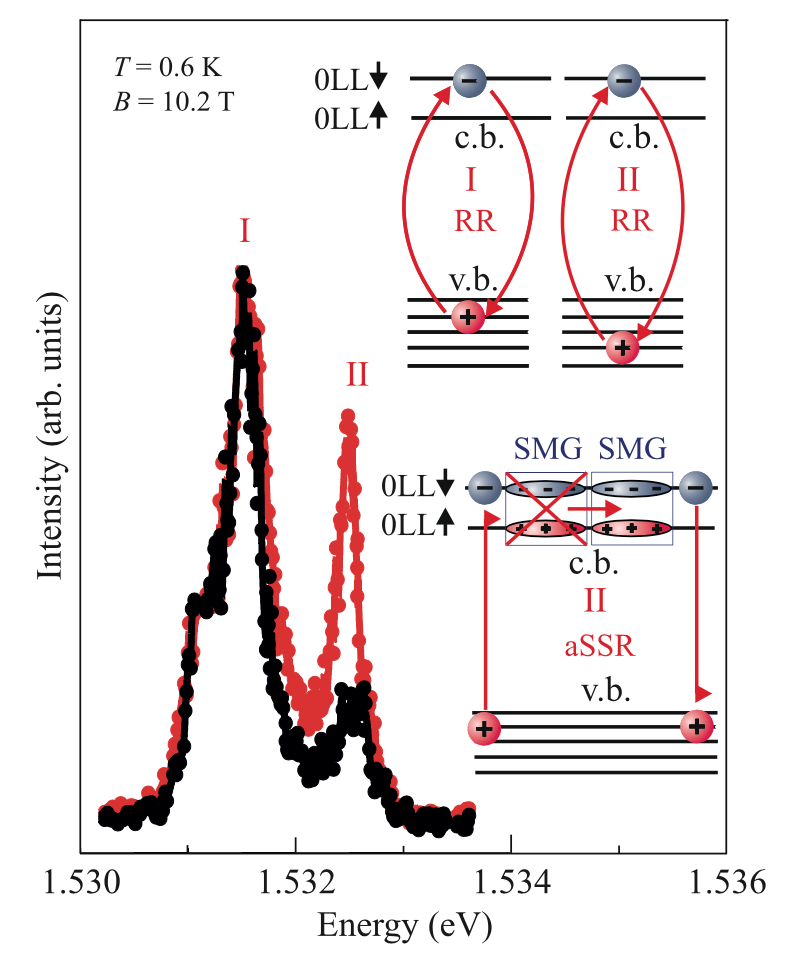
Reflection spectra of the Laughlin liquid at the electron filling factor 1/3 at different laser excitation powers (black dots represent weaker excitation, red dots represent stronger excitation). The diagrams show the processes of resonance reflection (RR) and anti-Stokes-Stokes Raman scattering (aSSR).
A.V.Larionov et.al,
JETP Letters 120, issue 6 (2024)