
 Home Home |
| For authors |
| Submission status |
| Current
|
| Archive
|
| Archive
(English)
|
| Search |

Half-metals are rather unusual and promising materials. The Fermi surface of a half-metal is completely spin-polarized. Namely, electronic states with only one spin projection value reach the Fermi energy. States with the other spin projection are pushed away from the Fermi level. This makes half-metals useful for spintronics. Typically, half-metallicity arises in strongly correlated electron systems, or when localized magnetic moments are present. We demonstrated that doping a density-wave insulator even in the weak-coupling limit may stabilize new types of half-metallic states, such as spin-valley half-metal and charge-density wave (CDW) half-metal.
In a simple model Hamiltonian describing two Fermi surface pockets (or valleys) with nesting, the electron-electron repulsion generates spin- or charge-density wave state, see Fig.1(a). If charge is added or removed from such a system, the situation becomes less clear-cut: several states with close energies are competing. Such possibilities as incommensurate density wave, electronic phase separation, stripes, etc. are discussed in the theoretical literature. We demonstrate that yet another type of many-body state is available. In the doped system, the two-valley Fermi surface emerges. One valley is electron-like. It is composed mostly of states of electron band, with spin σ. Another valley is hole-like, composed predominantly of states from hole band, with spin σ'. These Fermi surface valleys have half-metallic character: the states in electron band with spin -σ, as well as states in hole band with spin –σ', do not reach the Fermi level and have no Fermi surface.
Depending on the parameters, the spin polarizations of the electron-like valley and hole-like valley may be parallel (σ = σ') or antiparallel (σ = -σ'), see Fig.1(b,c). The former case is similar to the usual half-metal: quasiparticles at the Fermi surface are completely spin-polarized. In addition, the system exhibits a finite CDW order parameter. For this reason, we refer to such a state as the CDW half-metal. When σ = -σ', the total spin polarization averages to zero. It is proven, however, that in this situation, the so-called spin-valley polarization is nonzero. Thus, the state is called the spin-valley half-metal. The specific features of these half-metallic states are discussed. Namely, we demonstrate that the electric current can be accompanied by the transfer of spin or of the spin-valley quantum number. Such effects could be of interest for spintronics and pave the way to spin-valley-tronics. We also discussed the possibility of using the inelastic neutron scattering to detect the half-metallic states.
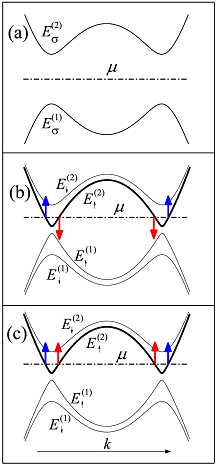
Band structure of (a) undoped density wave, (b) spin-valley and (c) charge density wave half-metals. Horizontal line shows the Fermi level, arrows indicate spin polarizations of the Fermi surface.
A.V. Rozhkov, A.O. Sboychakov, D.A Khokhlov and A.L. Rakhmanov and A.D. Kudakov
JETP Letters 112, issue 11 (2020)