
 Home Home |
| For authors |
| Submission status |
| Current
|
| Archive
|
| Archive
(English)
|
| Search |

The appearance of intense pulsed sources of terahertz (THz) radiation has generated the increasing interest in their influence on metal nanofilms, including ferromagnetic ones, which are components of THz optics and spintronics devices. In this field, one of the most important tasks is to study energy transport between the electrons and lattice at a nanoscale in the time domain under the irradiation of intense THz pulses.
In this work, using a hybrid pump-probe scheme of femtosecond interference microscopy, as a combination of the sample excitation by a subpicosecond THz pulse and of visible femtosecond probe pulses, the relaxation of the electron and lattice in a 25 nm thick nickel film sample near the melting point was explored.
The increase in reflection of the probe pulse at the moment of action of the THz pump pulse with a duration of 0.7 ps and a strength of 11 MV/cm is induced by the raise of the electron-electron collisions frequency in case of nonequilibrium heating, when electron temperature $T_e $ exceeds the lattice temperature $T_i$. The subsequent decrease in reflection during several picoseconds is caused by the heating of the lattice at the stage of temperature equilibration between $T_e $ и $T_i $. The variation of the complex permittivity indicates the onset of the nickel film melting in 5-10 ps after the THz exposure. The morphological studies by scanning electron and atomic force microscopy showed the surface modification of the film with a significant increase in its roughness after heating, apparently associated with the dewetting effect.
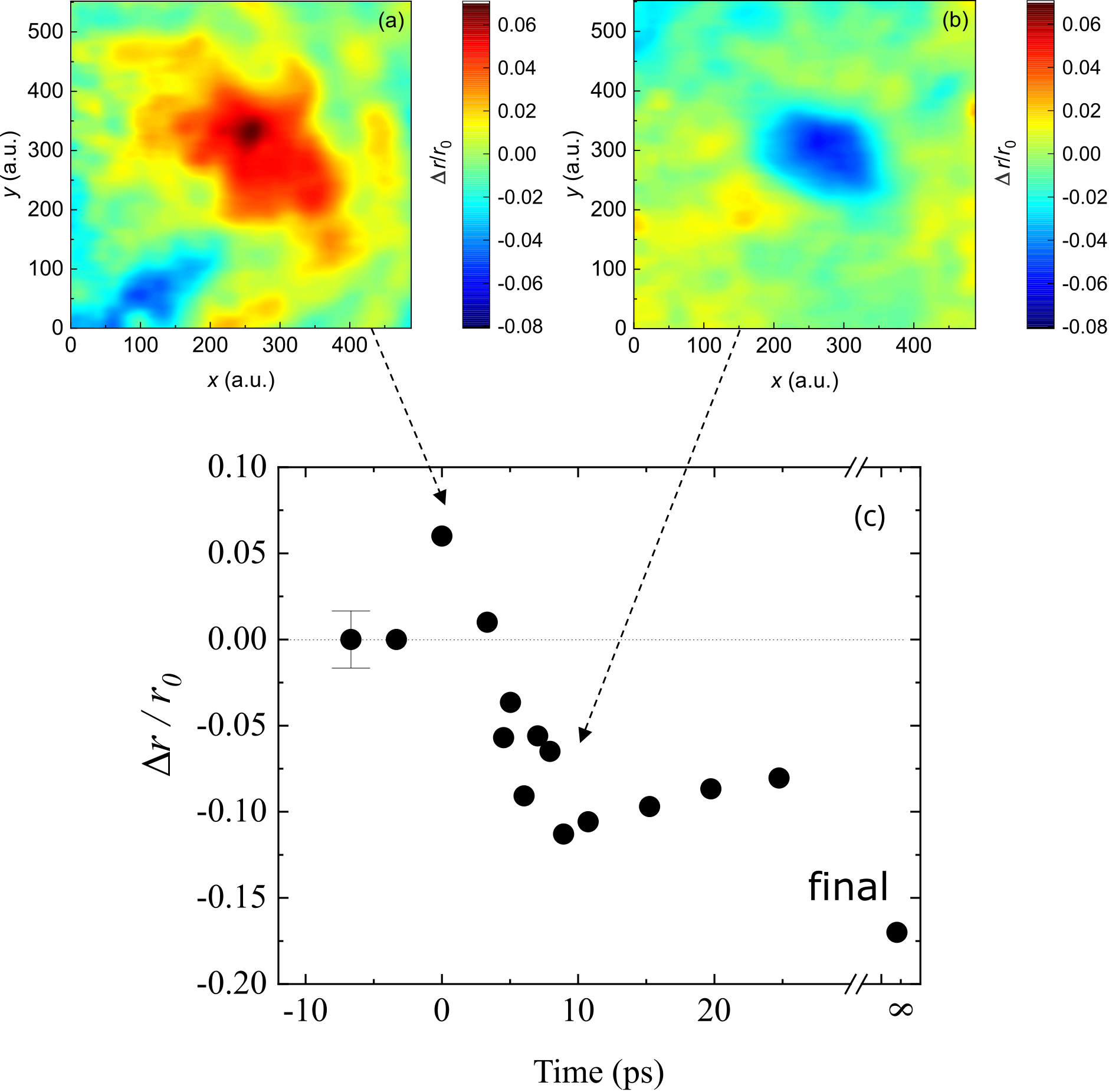
Fig 1 Spatial distributions of the reflectivity changes of probe for a time delay: a) - 0 ps, b) - 6.7 ps; c) - normalized reflection coefficient of the probe from the nickel film vs time.
S. I. Ashitkov, P. S. Komarov, A. V. Ovchinnikov, S. A. Romashevskiy,, E. V. Struleva, O.V. Chefonov, M. B. Agranat
JETP Letters 120, issue 8 (2024)