
 Home Home |
| For authors |
| Submission status |
| Current
|
| Archive
|
| Archive
(English)
|
| Search |

We consider the evolution of an initially planar monolayer of charged microparticles (plasma crystal) equilibrated in both horizontal (in the plane of the monolayer) and vertical parabolic confinements.We use the molecular dynamics simulations to study the buckling-like instability of such a system (using as an example the Yukawa type of interactions between the microparticles) at weakening of the vertical confinement. In particular, it is shown that the radial inhomogeneity of the plasma crystal leads to a qualitatively different character of the layering compared with homogeneous systems: the layering starts in the center of the crystal (where the interparticle distance is less than at periphery) and propagates with weakening of the vertical confinement as a layering wave that moves to the periphery. This effect explains remarkably well the behavior of plasma crystals observed in recent experiments with quasi 2D complex plasmas.
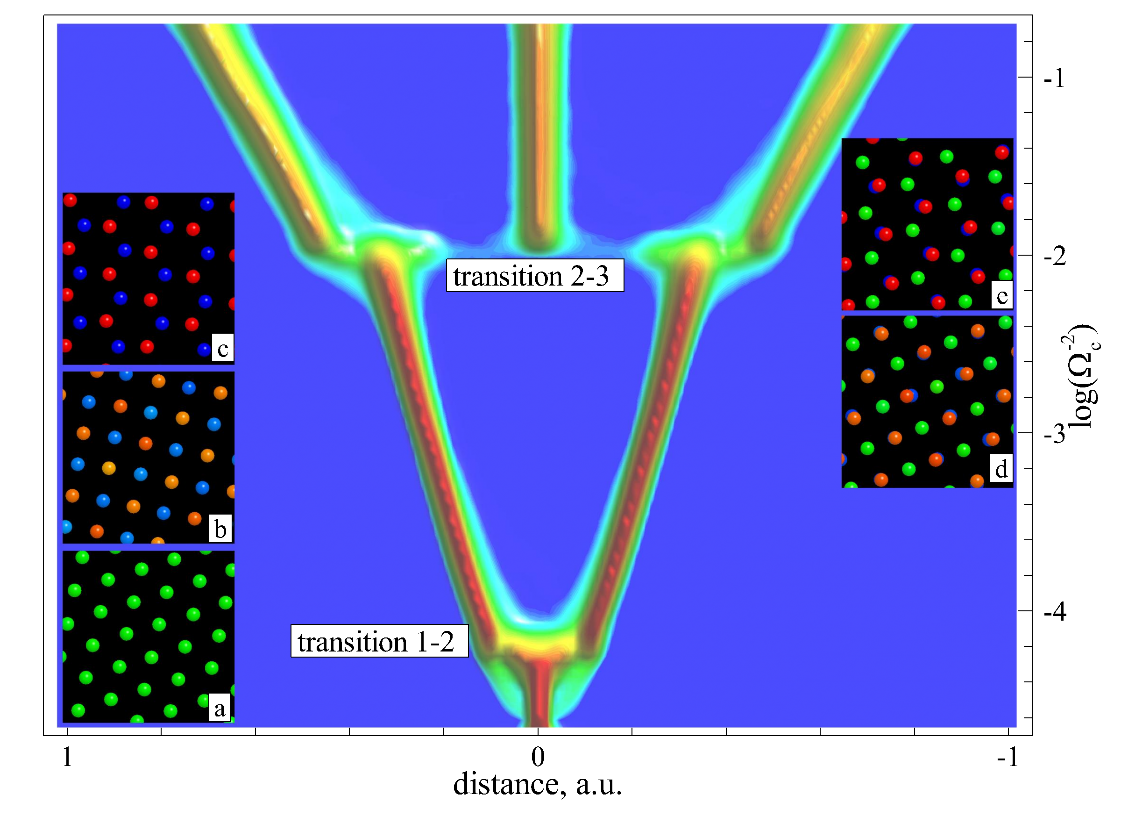
Layering of a planar plasma crystal at weakening of the vertical parabolic confinement. The distribution of particles over the height is shown as a function of on the parameter P characterizing the strength of the confinement. For small values P the system is a monolayer with a hexagonal symmetry (fragment is shown in panel (a)). When the parameter P is increased, the system spontaneously splits into two layers with a shifted square lattice (see, panel (b)). The color of the microparticles is determined by the height: the red particles are located above, and the blue ones are below. A further increase of P leads to a structural transition, i.e. the square lattice is transformed into a hexagonal one for each layer and they are shifted relative to each other (see, panel (c)). The subsequent increase of P leads to the formation of a third layer with the fcc type of symmetry (see, panel(d)), and the lattice transforms into an hcp lattice with hexagonal symmetry of all three layers (the case is shown in panel (e)) then.
B.A. Klumov
JETP Letters 118, issue11 (2023