
 Home Home |
| For authors |
| Submission status |
| Current
|
| Archive
|
| Archive
(English)
|
| Search |

Seven years ago, IceCube neutrino telescope has discovered neutrinos of Peta-electronvolt energies coming from yet unidentified astronomical sources. Active Galactic Nuclei (AGN) powered by supermassive black holes ejecting relativistic jets are considered as possible source of the IceCube astrophysical neutrino signal. Direct verification of this hypothesis is however difficult because of the low statistics of the neutrino signal and moderate angular resolution of the IceCube telescope.
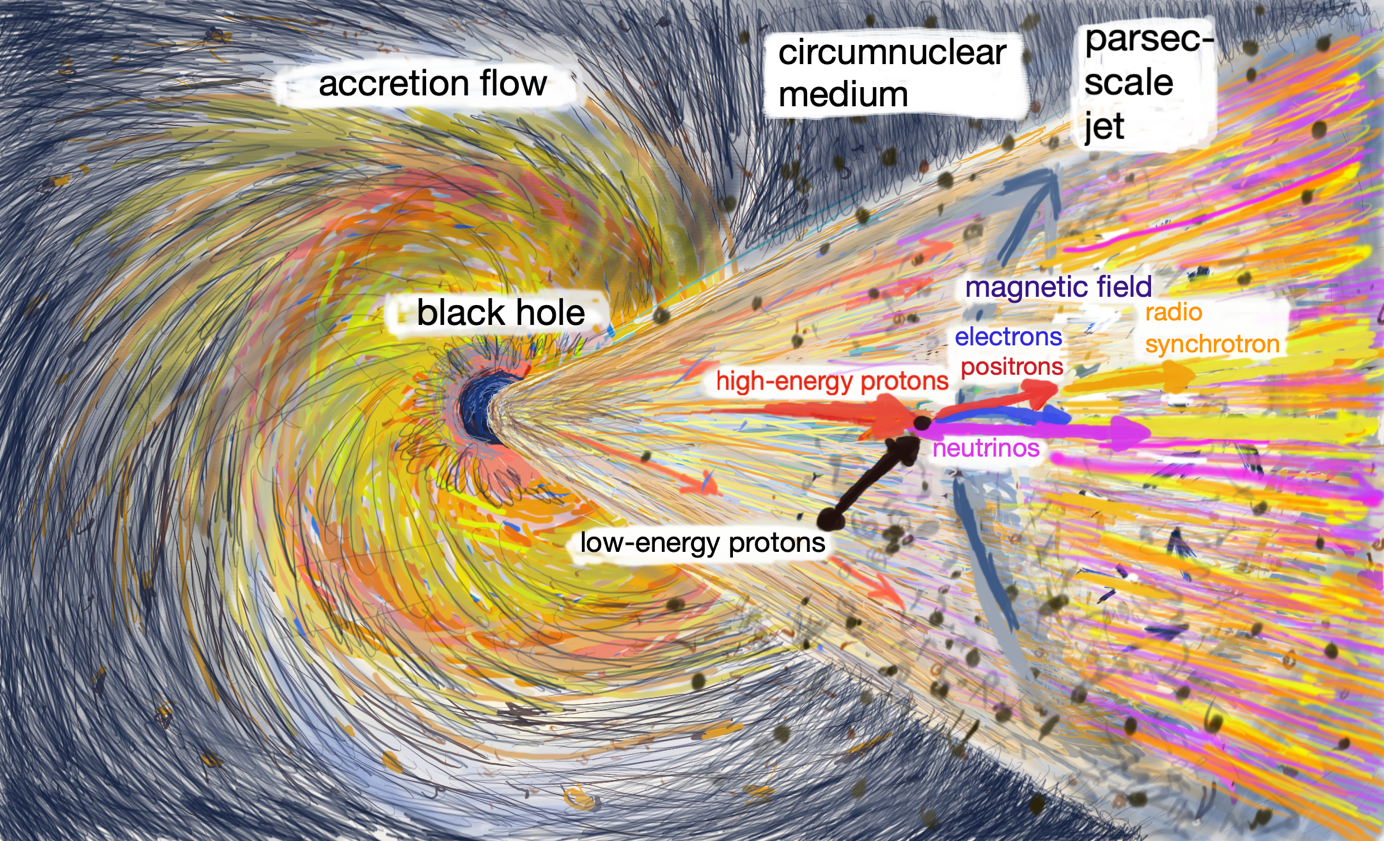
Interactions of high-energy protons and atomic nuclei that result in production of astrophysical neutrinos in AGN inevitably produce also gamma-rays, electrons and positrons that initiate electromagnetic cascade releasing its energy into Giga-electronvolt (GeV) to Tera-electronvolt (TeV) range. Thus, it is natural to expect that the sources of astrophysical neutrinos have GeV-TeV gamma-ray counterparts. However, contrary to expectations, arrival directions of astrophysical neutrinos detected by IceCube do not correlate with positions of brightest gamma-ray emitting AGN detected by Fermi LAT gamma-ray telescope. At the same time, surprisingly, recent analysis of correlation between neutrino arrival directions and positions of AGN brightest in the radio band by Plavin et al. (2020) has revealed significant correlation.
This is puzzling, because theoretical models of neutrino production in AGN typically assume that high-energy protons interact with ultraviolet photons produced by the hottest part of accretion flow onto the supermassive black hole, close to the AGN “central engine”. Its size is about the size of the Solar system, much smaller than that of the parsec-scale jets producing radio synchrotron emission. Moreover, the proton-photon reaction that can in principle produce both neutrinos and electrons / positrons has very high energy threshold. This reaction cannot directly produce electrons and positrons generating radio synchrotron emission.
The letter “Radio-to-gamma-ray synchrotron and neutrino emission from proton-proton interactions in active galactic nuclei” proposes a solution to these puzzles. High-energy protons in the AGN jet can efficiently interact on parsec-scale distances with low-energy protons from the circumnuclear medium. The energy threshold of proton-proton reaction that produces neutrinos, electrons and positrons is moderately low so that electrons with energies close to the threshold emit synchrotron radiation in the radio band. In this model the neutrino and radio fluxes are correlated because both are determined by the power of the primary proton beam reaching parsec-scale distances in the AGN jets.
A.Neronov, D. Semikoz
JETP Letters 113, issue 2 (2021)