
 Home Home |
| For authors |
| Submission status |
| Current
|
| Archive
|
| Archive
(English)
|
| Search |

Relativistic self-trapping of high-intensity ultra-short laser pulse (“laser bullet”) is manifested as formation of a 3D soliton structure in the form of a plasma cavity with evacuated background electrons filled by laser light and self-consistent plasma electric and magnetic fields – all propagating at almost speed of light in dense gas plasma. Such laser bullet propagates in plasma to distances exceeding the Rayleigh length considerably and requires certain matching of the size of the laser spot to the plasma density and the laser pulse intensity when the diffraction divergence is balanced by the relativistic nonlinearity such that the laser beam radius is unchanged during pulse propagation. Relativistic self-trapping of intense ultra-short laser pulse is similar to the so-called self-trapping of radiation of low-intensity quasi-stationary laser beam, which has been known since the 1960s for the quadratic nonlinearity of the medium’s dielectric permittivity and, as has been established now, takes place for the relativistic plasma nonlinearity as well.
Strong longitudinal plasma electric field of a laser bullet is able to accelerate significant number of electrons (up to tens of nC) with energies in the multi-hundred-MeV range. Currently, relativistic self-trapping is the best chose in terms of maximizing the total charge of the generated electron bunches for different applications, such as electron radiotherapy, radiation x-ray and gamma-ray sources, obtaining of photonuclear reaction products. However, the success in the implementation of such applications critically depends on the realization of the relativistic self-trapping mode in an inhomogeneous medium, since only this is possible in experiments.
This letter gives an answer to the possibility of self-trapping of extreme laser light (Fig. 1) in inhomogeneous plasma, that is important for targeted experiments. For the considered case of a near-critical density medium, (most promising for generation of high-current electron bunches) this letter is argued that relativistic self-trapping regime can be realized by proper focusing of a high-power laser pulse on a density profile at the vacuum-plasma interface. This justifies the possibility of creating an efficient source of high-energy electrons for socially significant applications.
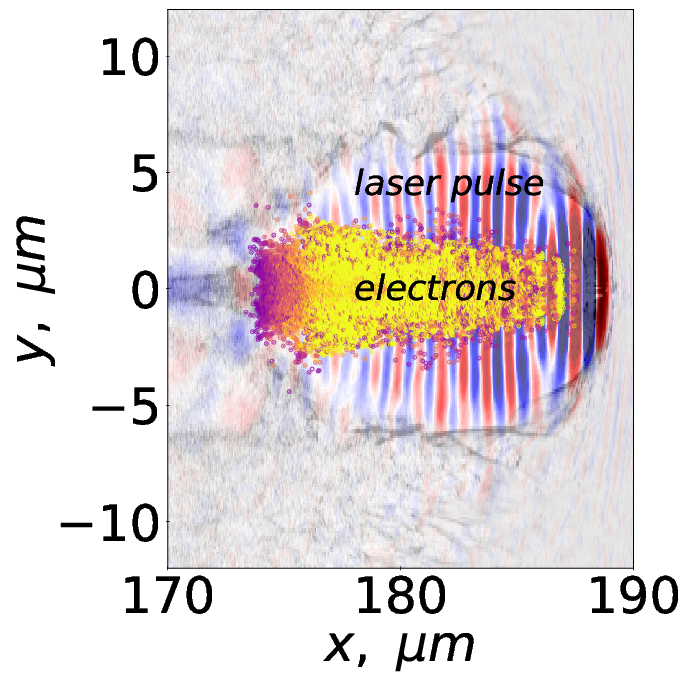
Fig.1 Plasma cavity with accelerated electrons for the relativistic self-trapping mode of laser pulse propagation.
V.Bychenkov, M.Lobok
JETP Letters 114, issue10 (2021)