
 Home Home |
| For authors |
| Submission status |
| Current
|
| Archive
|
| Archive
(English)
|
| Search |

Magnons are excitation quasiparticles of magnetically ordered crystals. Due to their weak interactions and low mass, they can form magnon Bose-Einstein condensates at sufficient density. Quantum transport of magnons over distances of several centimeters has been observed in yttrium iron garnet films [1].
Magnons obey Bose statistics, so external RF pumping excites only magnons in the quantum state of pre-existing magnon BEC (Boson amplification). We used this effect to create a continuously existing BEC by receiving the RF signal from the magnons, amplifying it, and feeding it back to the sample [2].
The natural frequency of the BEC is determined by the balance of magnon relaxation and excitation energies and the phase relationship in the feedback loop. As a result, we obtained a nonlinear quantum object with unique properties that functions even at room temperature [3].
When the magnetic field changes, the phase relationship in the feedback line abruptly changes by a multiple of 2 pi, leading to a new stable state. This switching of quantum states is in many ways similar to the properties of a phase-locked quantum qubit in superconductors. [3].
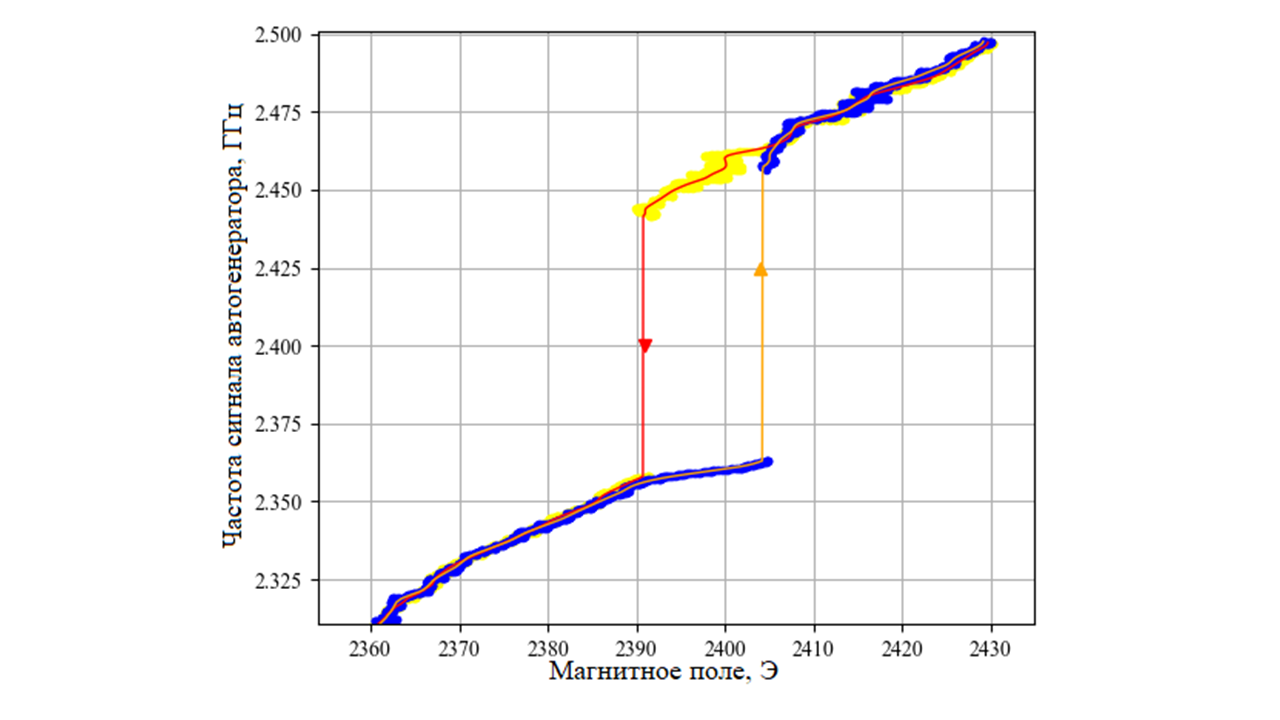
Fig. 1. Switching of magnon BEC states
[1]. G. A. Knyazev, A. N. Kuzmichev, P. E. Petrov, I. V. Savochkin, P. M. Vetoshko, V. I. Belotelov, and Yu.M. Bunkov, “Direct observation of the transition from spin waves to the magnon Bose condensate» Optics Express 32, 13761 (2024)
[2]. Yu. M. Bunkov, P. M. Vetoshko, G. A. Knyazev, A. N. Kuzmichev, D. A. Samodelkin, “Permanent Bose–Einstein Condensate”, JETP Letters 123, 119, (2026).
[3]. This article.
Yu.M.Bunkov et al.,
JETP Letters 123, issue 12 (2026)