
 Home Home |
| For authors |
| Submission status |
| Current
|
| Archive
|
| Archive
(English)
|
| Search |

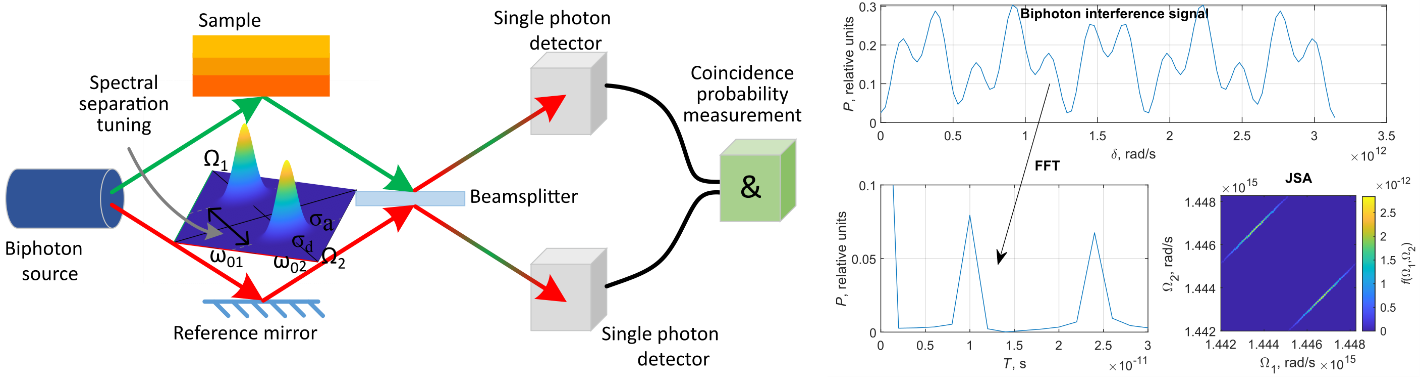
Optical coherence tomography (OCT) is a non-invasive imaging approach, expending the diagnostic possibilities in a wide range of tasks. An ability to resolve two closely located reflectors characterizes longitudinal spatial resolution, which is one of the most important characteristics of the OCT system. However, chromatic dispersion of the sample deteriorates the spatial resolution. Quantum OCT, based on the biphoton interferometery (general scheme is shown in figure 1, on the left), is widely considered as a means to cancel the dispersion effect.
The current Letter reports on a novel quantum OCT approach, based on interference of biphotons, that have different frequencies of the photons. It is shown that when the spectral separation between the photons is changed, the probability of coincident detection of the photons has an oscillating shape (an example of a spectral-domain biphoton interference signal is shown in figure 1 on the right).
The proposed spectral-domain quantum OCT approach was compared with traditional time-domain quantum OCT and classical OCT in terms of the longitudinal spatial resolution. It was analytically shown that when both the parasitic interference components and dispersion influence are taken into account, spatial resolutions of both time-domain quantum OCT and classical OCT are nearly the same, while the proposed spectral-domain quantum OCT can provide about 1.5-times better spatial resolution.
N. Ushakov, T. Makovetskaya,.A.Markvart, L.Liokumovich
JETP Letters 117, issue 1 (2023)