
 Home Home |
| For authors |
| Submission status |
| Current
|
| Archive
|
| Archive
(English)
|
| Search |

In an imbalanced bilayer electron system formed in a single wide (60 nm) GaAs quantum well, we have observed an unexpected drastic transformation of the sequence of quantum Hall effect (QHE) states when tilting the magnetic field from the normal to the plane of the bilayer system. The collective integer QHE states at total filling $\nu$ one and two are replaced by a set of fractional QHE states. Depending on the total electron density and its distribution between the two layers, controlled by the top- and back-gate voltages, the $\nu_F=4/3$, 6/5, 10/7 and 5/4 fractional quantum Hall states with both odd and even denominators have been observed. They typically come in pairs with two different fractions for a single field sweep. With a dual gate capacitive technique [1, 2], these fractional states have been identified as a combination of the integer QHE state at filling factor one in the layer with higher electron density (layer A) and fractional states at filling factors $\nu_F-1$ in the lower density layer (layer B). The observation of a pair of fractional states implies a redistribution of the electrons among both layers as the magnetic field is swept. This allows maintaining filling factor one in layer A, while facilitating a change to the other fractional filling factor in layer B. This is a new feature of co-existing QHE states in bilayer systems. Both the striking influence of tilting the magnetic field as well as the emergence of the 5/4 fractional quantum Hall state with 1/4 filling of layer B, deserve thorough theoretical analysis. Phenomenologically, the magnetic field component parallel to the layers impairs the coupling between them. We also note, that in our imbalanced samples the nearest neighbours for electrons in the lower density layer B are electrons of layer A, which can fundamentally change the manifestation of the electron-electron interaction. This may be responsible for the appearance of the even denominator 1/4 state in layer B. In general, the electron configuration studied here is promising for the quest for novel many body effects.
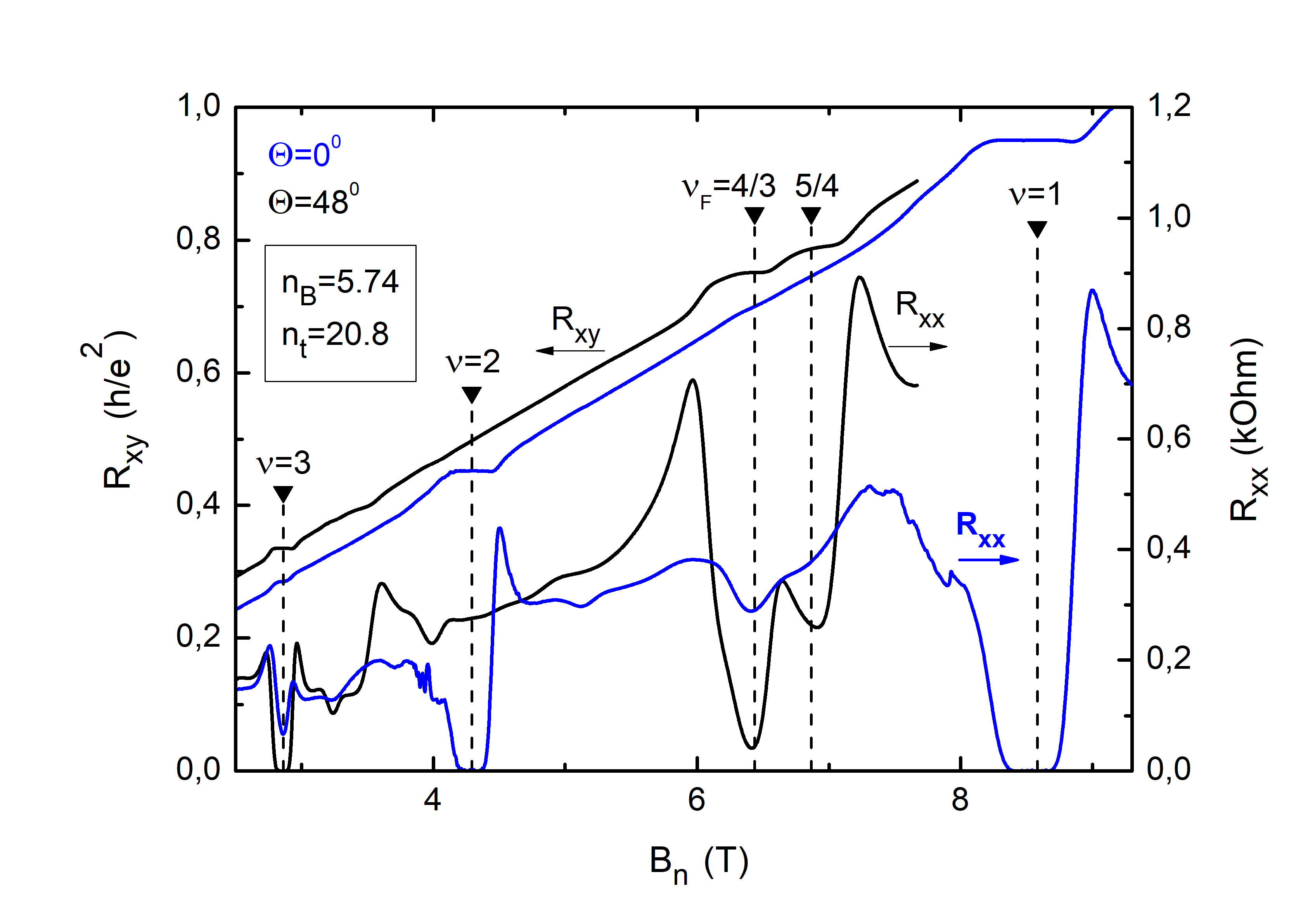
The magnetoresistance $R_{xx}$ (right scale) and Hall resistance $R_{xy}$ (left scale) versus normal component $B_n$ of magnetic field for two angles between the field and normal to the quantum well: $\Theta=0^{\circ}$ (blue lines) and $\Theta=48^{\circ}$ (black solid lines). Blue $R_{xy}$ line is shifted downwards by 0.05 for clarity. Vertical dashed lines show positions of total filling factors $\nu$ and $\nu_F$. The electron densities in the lower density layer $n_B$ (measured at low magnetic field) and in total electron system $n_t$ are given in units of $10^{10}$~cm$^{-2}$. Temperature $T=0.5$~K.
[1] S.I. Dorozhkin, A.A. Kapustin, I.B. Fedorov, V. Umansky, K. von Klitzing, and J.H. Smet, J. Appl. Phys. 123, 084301 (2018).
[2] S.I. Dorozhkin, A.A. Kapustin, I.B. Fedorov, V. Umansky, and J.H. Smet, Phys. Rev. B 102, 235307 (2020).
S. I. Dorozhkin, A. A. Kapustin, and I. B. Fedorov, V. Umansky, J.H. Smet
JETP Letters 117, issue 1 (2023)