
 Home Home |
| For authors |
| Submission status |
| Current
|
| Archive
|
| Archive
(English)
|
| Search |

One of the relevant tasks in modern hydrodynamics is the study of quantum turbulence, as well as the mechanisms of formation and decay of quantum vortices in quantum liquids and gases. Quantum vortices in superfluid helium‑4 are topological defects that must begin and end on the surface of the liquid or on the walls of the container [1], or they can form closed loops in the bulk [2]. The principal difference from classical vortices is the quantization of the flow circulation around the vortex core, with the circulation quantum being equal to $h/m_{He}$ , where is the Planck constant and $m_{He}$ is the mass of a helium‑4 atom.
Recent theoretical and experimental studies of the nonlinear interaction between waves propagating on the surface of a classical viscous fluid (for example, water) have demonstrated that the surface waves’ interaction can lead to the generation of vortex flows on the surface of a viscous fluid [3]. The features of vortex flow generation by waves on the surface of a quantum fluid, where normal and superfluid helium coexist simultaneously, had not been previously investigated theoretically. As our experiments [4] have shown, when the wave amplitudes exceed critical values, waves on the surface of He‑II can excite not only classical vortices in the normal helium but also quantum vortices under the surface of the liquid layer.
This work is devoted to studying the penetration depth of quantum vortices, which are formed during the nonlinear interaction of two mutually orthogonal capillary waves on the surface of the He‑II layer, into the liquid bulk at temperatures $T $ = 1.5 and 1.7 K. To detect the excitation of quantum vortices, negative charges (“electron bubbles” with a radius of 17 Å) were injected into liquid helium were used as tracer particles, which can be captured by quantum vortices at liquid temperatures below 1.7 K. It has been established that the quantum vortices generated by capillary waves with a frequency of $ f = 49.9 $ Hz are concentrated under the liquid surface in a narrow layer less than 50 nm deep, which is much less than the depth of the viscous sublayer of normal helium, $\delta \sim 5 μm$.
[1] P. Moroshkin, P. Leiderer, K. Kono, S. Inui and M. Tsubota, "Dynamics of the Vortex-Particle Complexes Bound to the Free Surface of Superfluid Helium", Phys. Rev. Lett. 122, 174502 (2019);
[2] P. M. Walmsley, A. I. Golov, H. E. Hall, A. A. Levchenko and W. F. Vinen, "Dissipation of Quantum Turbulence in the Zero Temperature Limit", Phys. Rev. Lett. 99, 265302 (2007);
[3] S. S. Vergeles, A. A. Levchenko and V. M. Parfenyev, "Nonlinear generation of currents by waves on liquid surface", Phys. Usp. 68, 1131 (2025);
[4] P. G. Selin, I. A. Remizov, M. R. Sultanova, E. V. Lebedeva, A. A. Levchenko and L. P. Mezhov-Deglin, "Threshold of Generation of Quantum Vortices by Waves on the Surface of Superfluid He-II", JETP Lett. 122, 178 (2025).
I.A. Remizov, P.G. Selin, E.V. Lebedeva et al.
JETP Letters 124, issue 8 (2026)
This work is motivated by recent experiments of V. V. Dmitriev's group, which investigated the effect of impurity magnetic scattering on the properties of the superfluid phases of 3He [1,2]. The experiments showed that the temperature range of the stable polar phase of superfluid 3He in a nematic aerogel vanishes when a small amount of solid paramagnetic 3He is present on the aerogel surface. In this case, a chiral polar-distorted A-phase with a finite degree of distortion emerges directly from the normal state instead of the axially symmetric polar phase.
We propose a microscopic mechanism for this instability based on the emergence of an effective spin-orbit interaction as quasiparticles scatter off the spatially inhomogeneous magnetic texture of the solid layer. Due to the finite curvature and roughness of the aerogel strands, a Berry curvature field is induced via magnetic correlations, lying primarily in the plane perpendicular to the anisotropy axis of aerogel. This interaction simultaneously breaks both the axial symmetry and the time-reversal invariance, which is essential for the observed effect.
Within Gorkov's equations in the p-wave channel, this double symmetry breaking introduces imaginary non-diagonal terms into the self-consistency matrix. Consequently, the pure polar phase no longer maximizes the transition temperature, yielding to the polar-distorted A-phase. In the limit where the interaction under consideration is strong enough, that is, when the non-diagonal elements of the perturbation matrix dominate over the difference between the diagonal ones, the solution approaches the form of the pure A-phase.
- V. V. Dmitriev, A. A. Soldatov, A. N. Yudin, "Effect of Magnetic Boundary Conditions on Superfluid 3He in Nematic Aerogel", Phys. Rev. Lett., 120, 075301 (2018)
-
V. V. Dmitriev, D. V. Petrova, A. A. Soldatov, A. N. Yudin, “The effect of pressure on the splitting of the superfluid transition in 3He in nematic aerogel”, Pis’ma v ZhETF, 124, 216 (2026)
Evgeny Surovtsev
JETP Letters 124, issue 7 (2026)
Quantization of the circulation of a magnon supercurrent was observed in a closed loop of yttrium-iron garnet film. Due to the low mass of magnons and their gaseous state at high concentrations, it was possible to obtain a magnon Bose-Einstein condensate at room temperature. [1]. According to the theory, the transition of magnons to a BEC state occurs when the precessing magnetization deviates by more than 2.5 degrees [2]. This phase transition has been experimentally observed precisely at this magnon concentration [3]. States with 2π and 4π circulation were observed. These states exhibit high stability. The circulation number is conserved under various changes in the phase difference of the radio-frequency pumping. It can be changed only by destroying and restoring the BEC with a new phase distribution. Thus, the magnon BEC possesses properties typical of the superfluid state! It should be noted that the kinematics of a magnon BEC is not described by the quasiclassical Landau-Lifshitz equations [1]. We also succeeded in creating a permanent magnon BEC using the method of auto-generation [4]. Thus, the magnon BEC represents a new platform for the development of quantum technologies at room temperature.
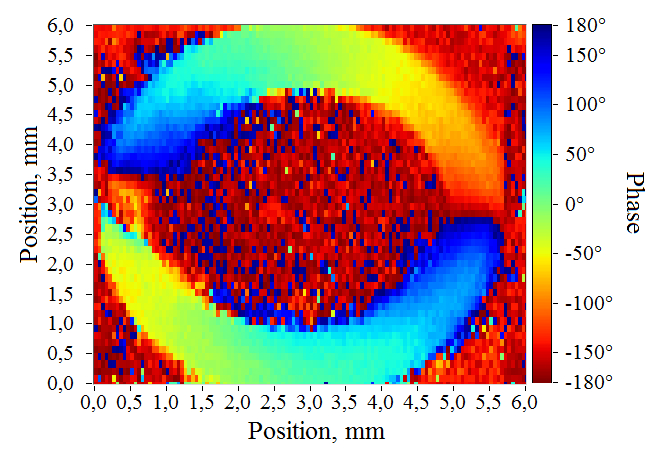
Fig.1. The phase shift of magnetization precession 4π along the YIG film ring
[1] G. A. Knyazev, A. N. Kuzmichev, P. E. Petrov, I. V. Savochkin, P. M. Vetoshko, V. I. Belotelov, and Yu. M. Bunkov, Optics Express 32, 13761-13768 (2024)
[2] Yu. M. Bunkov, V. L. Safonov, J. Mag. Mag. Mat., 452,30–34 (2018)
[3] P. E. Petrov, G. A. Knyazev, A. N. Kuzmichev, P. M. Vetoshko, V. I. Belotelov, and Yu. M. Bunkov, JETP Letters 119, 118 – 122 (2024).
[4]. Yu. M. Bunkov, P. M. Vetoshko, G. A. Knyazev, A. N. Kuzmichev, D. A. Samodelkin, JETP Letters 123, 119-123, (2026).
Bunkov Yu. et al.,
JETP Letters 124, issue 7 (2026)
Quantization of the circulation of a magnon supercurrent was observed in a closed loop of yttrium-iron garnet film. Due to the low mass of magnons and their gaseous state at high concentrations, it was possible to obtain a magnon Bose-Einstein condensate at room temperature. [1]. According to the theory, the transition of magnons to a BEC state occurs when the precessing magnetization deviates by more than 2.5 degrees [2]. This phase transition has been experimentally observed precisely at this magnon concentration [3]. States with 2π and 4π circulation were observed. These states exhibit high stability. The circulation number is conserved under various changes in the phase difference of the radio-frequency pumping. It can be changed only by destroying and restoring the BEC with a new phase distribution. Thus, the magnon BEC possesses properties typical of the superfluid state! It should be noted that the kinematics of a magnon BEC is not described by the quasiclassical Landau-Lifshitz equations [1]. We also succeeded in creating a permanent magnon BEC using the method of auto-generation [4]. Thus, the magnon BEC represents a new platform for the development of quantum technologies at room temperature.

Fig.1. The phase shift of magnetization precession 4π along the YIG film ring
1] G. A. Knyazev, A. N. Kuzmichev, P. E. Petrov, I. V. Savochkin, P. M. Vetoshko, V. I. Belotelov, and Yu. M. Bunkov, Optics Express 32, 13761-13768 (2024)
[2] Yu. M. Bunkov, V. L. Safonov, J. Mag. Mag. Mat., 452,30–34 (2018)
[3] P. E. Petrov, G. A. Knyazev, A. N. Kuzmichev, P. M. Vetoshko, V. I. Belotelov, and Yu. M. Bunkov, JETP Letters 119, 118 – 122 (2024).
[4]. Yu. M. Bunkov, P. M. Vetoshko, G. A. Knyazev, A. N. Kuzmichev, D. A. Samodelkin, JETP Letters 123, 119-123, (2026).
Bunkov Yu. et al.,
JETP Letters 124, issue 7 (2026)
Quantization of the circulation of a magnon supercurrent was observed in a closed loop of yttrium-iron garnet film. Due to the low mass of magnons and their gaseous state at high concentrations, it was possible to obtain a magnon Bose-Einstein condensate at room temperature. [1]. According to the theory, the transition of magnons to a BEC state occurs when the precessing magnetization deviates by more than 2.5 degrees [2]. This phase transition has been experimentally observed precisely at this magnon concentration [3]. States with 2π and 4π circulation were observed. These states exhibit high stability. The circulation number is conserved under various changes in the phase difference of the radio-frequency pumping. It can be changed only by destroying and restoring the BEC with a new phase distribution. Thus, the magnon BEC possesses properties typical of the superfluid state! It should be noted that the kinematics of a magnon BEC is not described by the quasiclassical Landau-Lifshitz equations [1]. We also succeeded in creating a permanent magnon BEC using the method of auto-generation [4]. Thus, the magnon BEC represents a new platform for the development of quantum technologies at room temperature.
Fig.1. The phase shift of magnetization precession 4π along the YIG film ring
1] G. A. Knyazev, A. N. Kuzmichev, P. E. Petrov, I. V. Savochkin, P. M. Vetoshko, V. I. Belotelov, and Yu. M. Bunkov, Optics Express 32, 13761-13768 (2024)
[2] Yu. M. Bunkov, V. L. Safonov, J. Mag. Mag. Mat., 452,30–34 (2018)
[3] P. E. Petrov, G. A. Knyazev, A. N. Kuzmichev, P. M. Vetoshko, V. I. Belotelov, and Yu. M. Bunkov, JETP Letters 119, 118 – 122 (2024).
[4]. Yu. M. Bunkov, P. M. Vetoshko, G. A. Knyazev, A. N. Kuzmichev, D. A. Samodelkin, JETP Letters 123, 119-123, (2026).
Bunkov Yu. et al.,
JETP Letters 124, issue 7 (2026)
Experimental studies of compact soft X-ray sources (wavelength 1 Å < λ < 50 Å) often require obtaining a two-dimensional image of the source with high spatial resolution. The simplest instrument for obtaining such an image is a pinhole, which consists of a small-size orifice in a material opaque to the radiation. When the X-ray source has low intensity, the pinhole diameter may be increased to obtain a reliably detectable image on the detector. However, thereby the spatial resolution at the object reduces. In this paper, we propose the method for improving the spatial resolution of images recorded using large-aperture (i.e. enable high radiation pass through ability) pinholes. The method is an image reconstruction with a mathematical procedure based on a solution of an ill-posed problem – the Fredholm integral equation of the 1st kind – with an iteration algorithm. This algorithm is known as the minimization of directed divergences or the maximum likelihood. For our purpose, we have created a special instrumental function and modified the algorithm for its application to the reconstruction of images recorded with large-aperture pinholes and developed the appropriate software.
Model experiments and reconstructions of images obtained in actual experiments with electric-discharge sources have demonstrated the high efficiency of the proposed iteration method for improving (by few times) the spatial resolution of images recorded by large-aperture pinholes. Thus, the reconstructed images have a spatial resolution significantly better than the native geometric resolution of these pinholes. Figure 1 presents the result of a model experiment on reconstructing the image of two closely spaced point sources to demonstrate the efficiency of the developed method.
Proposed approach has implemented to use large-aperture pinholes in experimental diagnostics for studying low-intensity, small-scale emitting objects. These pinholes are simple to fabricate and possess high radiation pass through ability, but previously they were generally not used due to their inherently low geometric spatial resolution.

Fig. 1. Image of the model source (consisting of two closely located point sources) recorded through the large‑aperture pinhole (a). The image of this model source reconstructed using the developed method with the special instrumental function (b). Pixel numbers are plotted along the coordinate axes. The color scale corresponds to intensity gradations.
Evgeny Bolkhovitinov et al.,
JETP Letters 124, issue 7 (2026)
Grigori Volovik - 80

Warmest congratulations to our colleague Grigori Yefimovich Volovik, born 07/09/1946, member of the Editorial Board of JETP Letters and a Deputy Editor since 1991, on the occasion of his 80th birthday.
Grigori’s ascent to the elite of theoretical physics has been pretty straightforward and swift: in 1964 he became a student of the Moscow Institute of Physics and Technology (MIPT); upon having passed a needle eye of close to 20 applications per place he was selected by none but P.L. Kapitsa as a student to his chair of low temperature physics. He was subsequently one of the top students in the Class of 1970 at the MIPT Faculty of General and Applied Physics and continued as PhD student at the Landau Institute of Theoretical Physics (Landau ITP); ever since 1973 he is a staff member of Landau ITP, a principal researcher since 1994. Grigori defended his PhD thesis in 1973 and habilitated in 1982.
Grigori’s moment of glory came in 1975 when he, in collaboration with V.P. Mineyev, turned his eye on the rich topological properties of the superfluid He-3, and subsequently extended the developed technique to superconductivity. Eventually, he became a world renowned guru in this field of physics. A
longside his work at the Landau Institute, in 1993, Grigory became a professor at the Low Temperature Laboratory of the Helsinki University of Technology, and in 2001 became a foreign member of the Finnish Academy of Science and Letters, followed by election in 2007 to the German National Academy of Sciences Leopoldina.
The results of this series of studies are summarized in the monograph Exotic properties of superfluid 3He (World Scientific, 1992). Also in 1992. Grigory became, together with V.P. Mineev, winner of the Landau gold medal, and in 2014, Grigori, jointly with V.P. Mineev, was awarded the Lars Onsager prize of the American Physical Society for «their contribution to a comprehensive classification of topological defects in condensed matter phases with broken symmetry, culminating in the prediction of half-quantum vortices in superfluid He-3 and related systems.”
An important part of Gregory’s scientific biography is the famous book The Universe in a Helium Droplet (Clarendon Press, Oxford 2003, 2nd edition 2009, 4000+ citations). It is based on his new series of works extending concepts that proved so successful in the study of superfluidity and superconductivity to problems concerning phase transitions and topological defects in the Universe, as well as to the Standard Model of particle physics.
For this series of studies, Grigory was awarded the 2004 Simon Memorial Prize, with the citation «for his pioneering research on the effects of symmetry in superfluids and superconductors and for extending these concepts to quantum field theory, cosmology, quantum gravity and particle physics».
Grigory continues to work tirelessly in the field of theoretical physics, constantly expanding his list of publications (which has by now exceeded 500), and on the journal’s editorial board—as deputy editor-in-chief and a “guru” in the field of condensed matter theory.
The Editorial Board of JETP Letters wishes the honoree robust health, longevity, and we look forward to more inspiration from his studies and continuous advantage from his expertise in our Board.
The extraction of the proton beam circulating in a ring accelerator using a bent single crystal was carried out in a number of research centers (JINR, IHEP, CERN, FNAL). The proton beam was directed strictly perpendicular to the surface of the single crystal at a small angle (smaller than the Lindhard angle) relative to the curved crystallographic planes. This geometry of particle capture in the planar channeling mode is called end‑face capture. This paper presents the results of extracting a proton beam from an accelerator using the phenomenon of volume particle capture in the channeling mode. In this case, the proton beam is directed at the crystal at an angle many times greater than the Lindhard angle. As the proton moves in the bent crystal, the angle between the particle veloсity and the plane decreases over a short distance, and the particle moves almost parallel to the plane.In this region, due to multiple scattering on atoms, a particle has a probability of being captured into the channeling mode (i.e., transitioning from an over‑barrier state to an under‑barrier one). The figure illustrates both types of particle capture into channeling.
The extraction of a proton beam using particle capture into channeling was implemented for the first time in the world’s accelerator practice at the SPASCHARM facility at the Institute for High Energy Physics. When pointing a primary beam with an intensity of $3\times 10^{11}$ protons/cycle at a crystal in the ring of the U-70 accelerator at the SPASCHARM installation, an intensity of up to $6\times 10^6$ protons/cycle was observed. Despite the lower intensity of the output beam compared to the traditional output based on the face-end capture of particles, the output using the phenomenon of volume capture provides more stable parameters of the output beams.
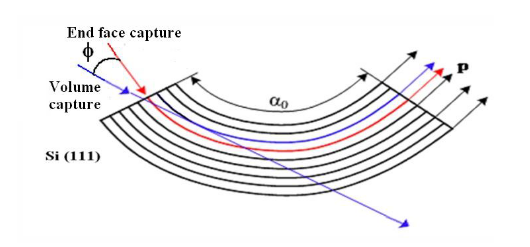
Figure 1: Scheme of particle extraction at volume capture
S.F.Reshetnikov et al.
JETP Letters 124, issue 5 (2026)
The unusual ground state doublet of the 229Th nucleus with the low energy M1(8.4 eV) transition between the nuclear states and the electron shell of the thorium ions with the similar electron transition represent two qubits spatially inserted one within the other. In the case of approximate equality of the energies of these transitions, weakly damped oscillations can be excited between these qubits, namely, multiple coherent energy transfer from the electron shell to the nucleus and vice versa. Due to the relatively high interaction energy of the electron and nuclear currents this process in the 229Th ions does not require resonant coincidence of the transition energies. The electron shell, transitioning between two electron states, “breathes”, periodically decreasing and increasing in size and plays the role of a kind of resonator for the virtual photon emitted by the nucleus.

Fig. Multiple exchange of excitation energy between the nucleus and its electron shell.
E.V. Tkalya
JETP Letters 124, issue 5 (2026)
The formation of impurity-induced bound states of a particle hopping over lattice sites is one of the fundamental effects of quantum physics described in numerous textbooks. In the case of the nearest-neighbor hopping, a bound state arises for any strength of the attractive on-site impurity potential W in one- and two-dimensional cases (1D and 2D) and if the strength exceeds a critical value in the three-dimensional (3D) case (this value is determined by the ratio of W/t, where t is the hopping amplitude). The quantum statistics play no role in this single-particle problem. In particular, a similar behavior exhibits a composite boson, formed by two strongly bound fermion species if it is considered as a structureless hard-core particle with an effective hopping amplitude teff = t2/U (U >> t is the strong on-site attraction of the different species) in the presence of an impurity with a non-zero potential acting on the boson as a whole.
Remarkably, that when placed near a single-site "magnetic" impurity—which exerts an opposite effect on its constituent fermions— the composite boson exhibits interesting differences from the well-known single-particle case.
In this case the “classical” potential energy of the bound fermion pair does not depend on the lattice site and this infinite degeneracy is eliminated only through quantum virtual processes of dissociation and recombination. In addition to the band dispersion, these processes also generate an effective impurity potential that extends to the impurity site and its nearest neighbors. This emergent potential gives rise to a rich spectrum of localized states. Besides the usual symmetric bound state, the composite boson supports additional bound states of different orbital symmetry. We determine the energies of these states and the critical impurity strengths required for their formation in one-, two-, and three-dimensional lattices. Notably, the critical conditions are universal: they depend only on the ratio W/U and are independent of the hopping amplitude. Thus, the internal structure of a composite quantum particle can qualitatively transform even the simplest impurity problem. The predicted bound states — analogous to Yu–Shiba–Rusinov states in the weak coupling (BCS) regime — may be relevant to strongly correlated lattice systems, including ultracold atoms in optical lattices, excitonic systems, and other platforms supporting tightly bound quantum pairs.
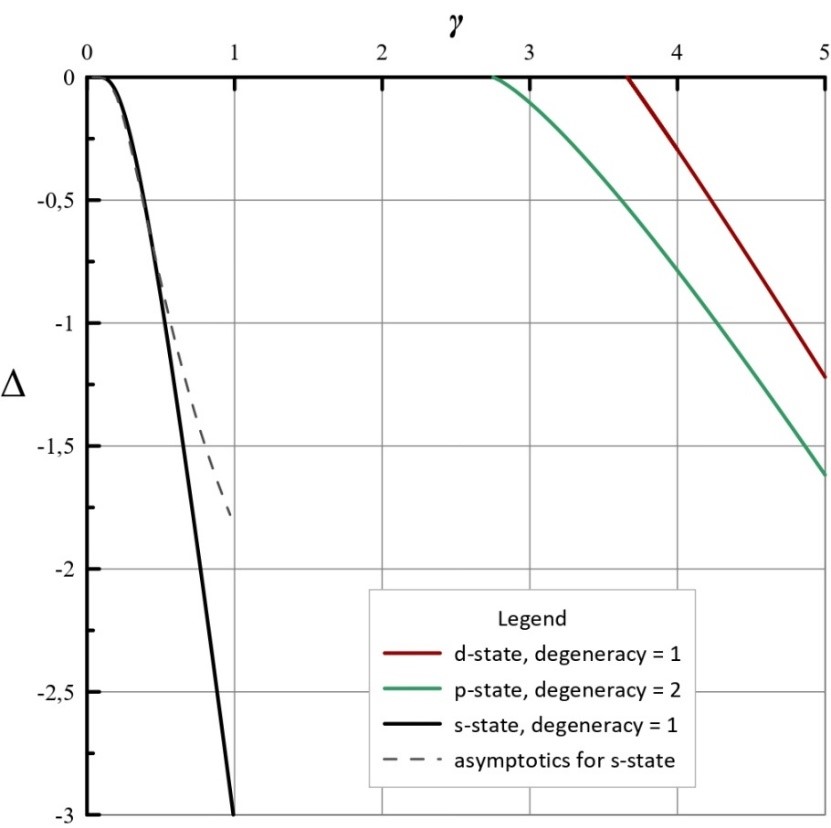
The dependence of the energy of a bound state (counted from the bottom of the band) on the effectiveimpurity strength parameter 𝛾 for a 2D square lattice.
L.I.Knyazeva, V.I.Yudson
JETP Letters 124, issue 4 (2026)